EX-99.3
Published on January 28, 2026
©2026 Concentra Inc. All rights reserved. Concentra Investor Book January 2026 Improving the health of America’s workforce, one patient at a time

©2026 Concentra Inc. All rights reserved.
3 Forward-Looking Statements This presentation contains forward-looking statements that express Concentra Group Holdings Parent, Inc.'s ("Concentra," the "Company," "we" or "our") current opinions, expectations, beliefs, plans, objectives, assumptions or projections regarding future events or future results that include, but are not limited to, financial guidance and other projections and forecasts. Forward looking statements include statements that are not historical facts and can be identified by terms such as “anticipate,” “believe,” “could,” “estimate,” “expect,” “intend,” “may,” “plan,” “potential,” “predict,” “preliminary,” “project,” “seek,” “should,” “underpin,” “will,” “would” or similar expressions and the negatives of those terms. These forward- looking statements involve a number of risks, uncertainties (some of which are beyond the Company’s control) or other assumptions that may cause actual results or performance to be materially different from those expressed or implied by these forward-looking statements. These risks and uncertainties include, but are not limited to, those factors described in the Company’s filings with the Securities and Exchange Commission (“SEC”), including those under “Risk Factors” therein. Should one or more of these risks or uncertainties materialize, or should any of the assumptions prove incorrect, actual results may vary in material respects from those projected in these forward-looking statements. Actual results may differ materially from these expectations due to changes in global, regional or local economic, business, competitive, market, regulatory and other factors, many of which are beyond the Company’s control. Any forward looking statements made by the Company in this presentation speak only as of the date of this presentation and are expressly qualified in their entirety by the cautionary statements included in this presentation. Factors or events that could cause the Company’s actual results to differ may emerge from time to time, and it is not possible for the Company to predict all of them. The Company may not actually achieve the plans, intentions or expectations disclosed in its forward looking statements and you should not place undue reliance on its forward looking statements. The Company’s forward looking statements do not reflect the potential impact of any future acquisitions, mergers, dispositions, joint ventures, investments or other strategic transactions it may make. The Company does not undertake any obligation to update or revise any forward-looking statements, whether as a result of new information, future events or otherwise, except as may be required under applicable securities laws. Use of Non-GAAP Financial Information In order to provide investors with greater insight, promote transparency and allow for a more comprehensive understanding of the information used by management in its financial and operational decision making, the Company supplements its condensed consolidated financial statements presented on a GAAP basis herein with certain non-GAAP financial information, including reconciliations of these non-GAAP measures to their most directly comparable available GAAP measures, which are included in this presentation, as well as in the Company’s quarterly financial press releases and related Form 8-K filings with the SEC. This information can be accessed for free by visiting www.concentra.com or www.sec.gov. We believe that the presentation of Adjusted EBITDA, Adjusted EBITDA margin, Adjusted Net Income Attributable to the Company, Free Cash Flow and FCF Conversion, as defined herein, are important to investors because Adjusted EBITDA, Adjusted EBITDA margin, Adjusted Net Income Attributable to the Company, Free Cash Flow and FCF Conversion are commonly used as an analytical indicator of performance by investors within the healthcare industry. Adjusted EBITDA, Adjusted EBITDA margin, Adjusted Net Income Attributable to the Company, Free Cash Flow and FCF Conversion are used by management to evaluate financial performance of, and determine resource allocation for, each of our operating segments. However, Adjusted EBITDA, Adjusted EBITDA margin, Adjusted Net Income Attributable to the Company, Free Cash Flow and FCF Conversion are not measures of financial performance under U.S. GAAP. Items excluded from Adjusted EBITDA, Adjusted EBITDA margin, Adjusted Net Income Attributable to the Company, Free Cash Flow and FCF Conversion are significant components in understanding and assessing financial performance. Adjusted EBITDA, Adjusted EBITDA margin, Adjusted Net Income Attributable to the Company, Free Cash Flow and FCF Conversion should not be considered in isolation, or as an alternative to, or substitute for, net income, net income margin, income from operations, cash flows generated by operations, investing or financing activities, or other financial statement data presented in the consolidated financial statements as indicators of financial performance or liquidity. Because Adjusted EBITDA, Adjusted EBITDA margin, Adjusted Net Income Attributable to the Company, Free Cash Flow and FCF Conversion are not measurements determined in accordance with U.S. GAAP and are thus susceptible to varying definitions, Adjusted EBITDA, Adjusted EBITDA margin, Adjusted Net Income Attributable to the Company, Free Cash Flow and FCF Conversion as presented may not be comparable to other similarly titled measures of other companies. We define Adjusted EBITDA as earnings excluding interest, income taxes, depreciation and amortization, gain (loss) on early retirement of debt, stock compensation expense, separation transaction costs, Nova Medical Centers ("Nova") and Onsite Innovations, LLC ("Pivot Onsite Innovations") acquisition costs, gain (loss) on sale of businesses, and equity in earnings (losses) of unconsolidated subsidiaries. We define Adjusted EBITDA margin as Adjusted EBITDA divided by revenue. We define Adjusted Net Income Attributable to the Company as Net Income Attributable to the Company plus tax-affected adjustments for Loss on Early Retirement of Debt, Separation Transaction Costs, and Nova and Pivot Onsite Innovations Acquisition Costs. We define Free Cash Flow as cash flow from operations less cash flow from investing activity (excluding business combinations, net of cash acquired). We define FCF Conversion as Free Cash Flow divided by net income. We will refer to Adjusted EBITDA, Adjusted EBITDA margin, Adjusted Net Income Attributable to the Company, Free Cash Flow and FCF Conversion throughout these materials. Preliminary Financial Results Financial results for the quarter ended December 31, 2025 and fiscal year ended December 31, 2025 are preliminary, based solely upon management estimates and currently available information, without audit or consolidating adjustments and subject to change. There can be no assurance that our final results for the quarter ended December 31, 2025 and fiscal year ended December 31, 2025 will be consistent with these estimates, and any differences could be material. These estimates are neither guarantees of actual performance nor guarantees of, or indicative of, future performance. You should exercise caution in relying on these estimates and you should not draw any inferences from these estimates regarding financial and/or other data not provided or available. No Duty to Update Any statements made herein are made as of December 31, 2025 unless otherwise noted, and should not be relied upon as representing the Company’s views as of any subsequent date. The Company undertakes no obligation to update or revise information contained herein as a result of new information, future events, or otherwise, except as required by applicable law. Disclaimer
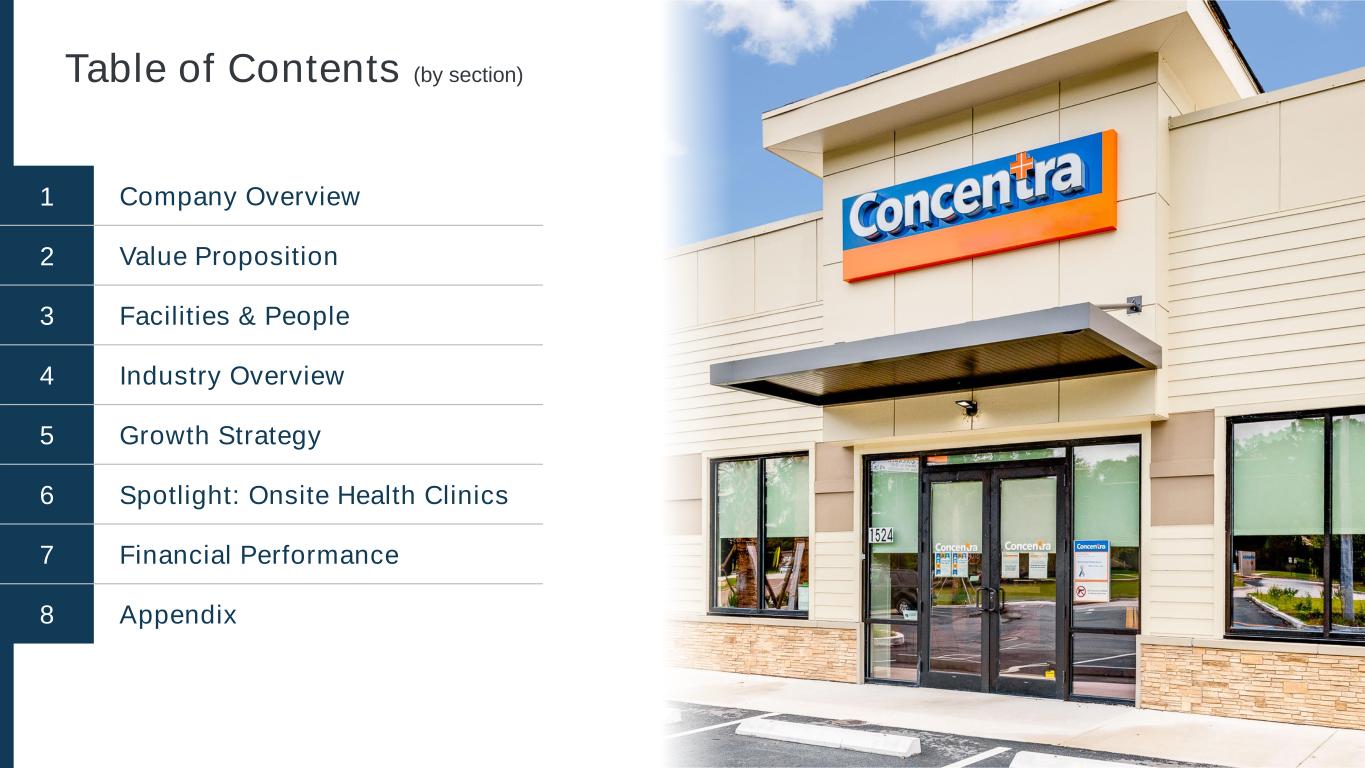
4 1 Company Overview 2 Value Proposition 3 Facilities & People 4 Industry Overview 5 Growth Strategy 6 Spotlight: Onsite Health Clinics 7 Financial Performance 8 Appendix Table of Contents (by section)
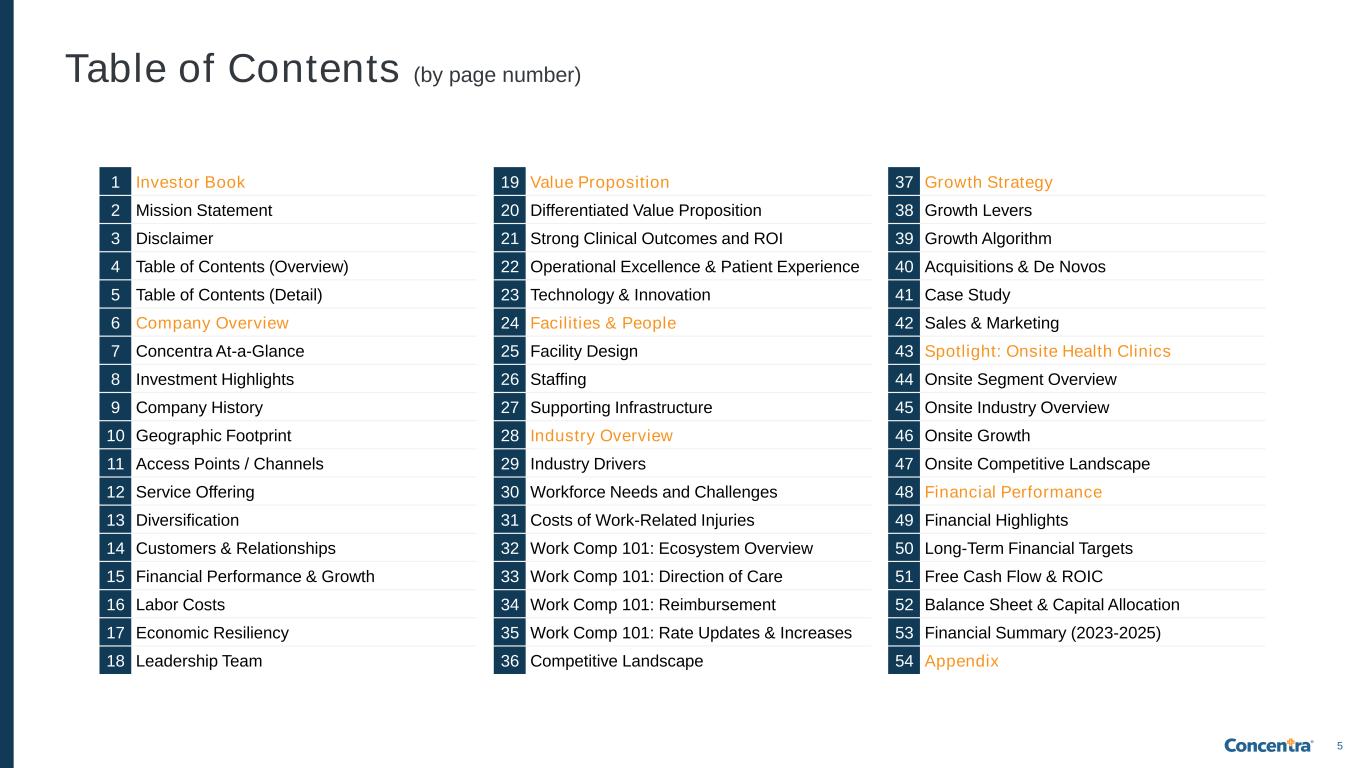
5 Table of Contents (by page number) 1 Investor Book 19 Value Proposition 37 Growth Strategy 2 Mission Statement 20 Differentiated Value Proposition 38 Growth Levers 3 Disclaimer 21 Strong Clinical Outcomes and ROI 39 Growth Algorithm 4 Table of Contents (Overview) 22 Operational Excellence & Patient Experience 40 Acquisitions & De Novos 5 Table of Contents (Detail) 23 Technology & Innovation 41 Case Study 6 Company Overview 24 Facilities & People 42 Sales & Marketing 7 Concentra At-a-Glance 25 Facility Design 43 Spotlight: Onsite Health Clinics 8 Investment Highlights 26 Staffing 44 Onsite Segment Overview 9 Company History 27 Supporting Infrastructure 45 Onsite Industry Overview 10 Geographic Footprint 28 Industry Overview 46 Onsite Growth 11 Access Points / Channels 29 Industry Drivers 47 Onsite Competitive Landscape 12 Service Offering 30 Workforce Needs and Challenges 48 Financial Performance 13 Diversification 31 Costs of Work-Related Injuries 49 Financial Highlights 14 Customers & Relationships 32 Work Comp 101: Ecosystem Overview 50 Long-Term Financial Targets 15 Financial Performance & Growth 33 Work Comp 101: Direction of Care 51 Free Cash Flow & ROIC 16 Labor Costs 34 Work Comp 101: Reimbursement 52 Balance Sheet & Capital Allocation 17 Economic Resiliency 35 Work Comp 101: Rate Updates & Increases 53 Financial Summary (2023-2025) 18 Leadership Team 36 Competitive Landscape 54 Appendix

Company Overview
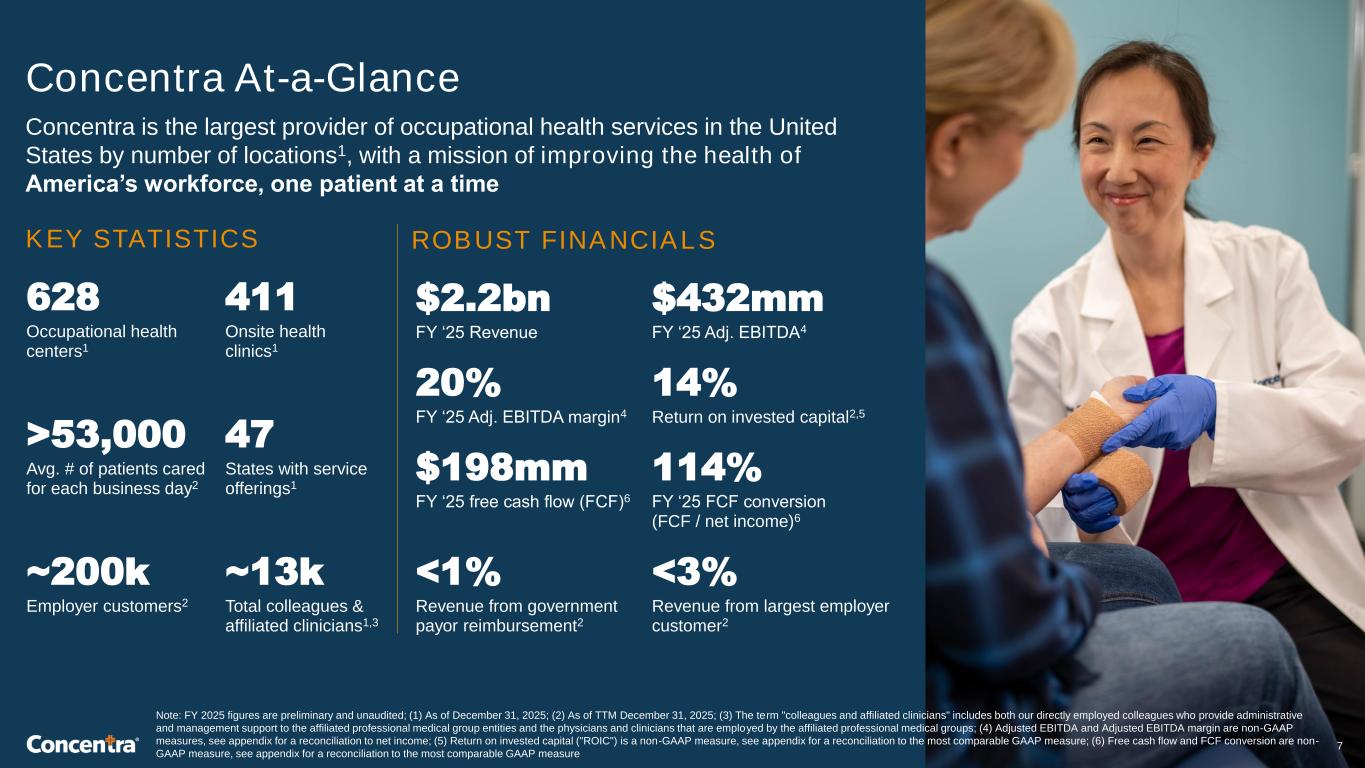
©2026 Concentra Inc. All rights reserved. Concentra At-a-Glance Concentra is the largest provider of occupational health services in the United States by number of locations1, with a mission of improving the health of America’s workforce, one patient at a time KEY STATISTICS ~13k Total colleagues & affiliated clinicians1,3 ~200k Employer customers2 47 States with service offerings1 >53,000 Avg. # of patients cared for each business day2 ROBUST FINANCIALS $2.2bn FY ‘25 Revenue $432mm FY ‘25 Adj. EBITDA4 411 Onsite health clinics1 628 Occupational health centers1 <1% Revenue from government payor reimbursement2 <3% Revenue from largest employer customer2 Note: FY 2025 figures are preliminary and unaudited; (1) As of December 31, 2025; (2) As of TTM December 31, 2025; (3) The term "colleagues and affiliated clinicians" includes both our directly employed colleagues who provide administrative and management support to the affiliated professional medical group entities and the physicians and clinicians that are employed by the affiliated professional medical groups; (4) Adjusted EBITDA and Adjusted EBITDA margin are non-GAAP measures, see appendix for a reconciliation to net income; (5) Return on invested capital ("ROIC") is a non-GAAP measure, see appendix for a reconciliation to the most comparable GAAP measure; (6) Free cash flow and FCF conversion are non- GAAP measure, see appendix for a reconciliation to the most comparable GAAP measure 7 20% FY ‘25 Adj. EBITDA margin4 14% Return on invested capital2,5 114% FY ‘25 FCF conversion (FCF / net income)6 $198mm FY ‘25 free cash flow (FCF)6
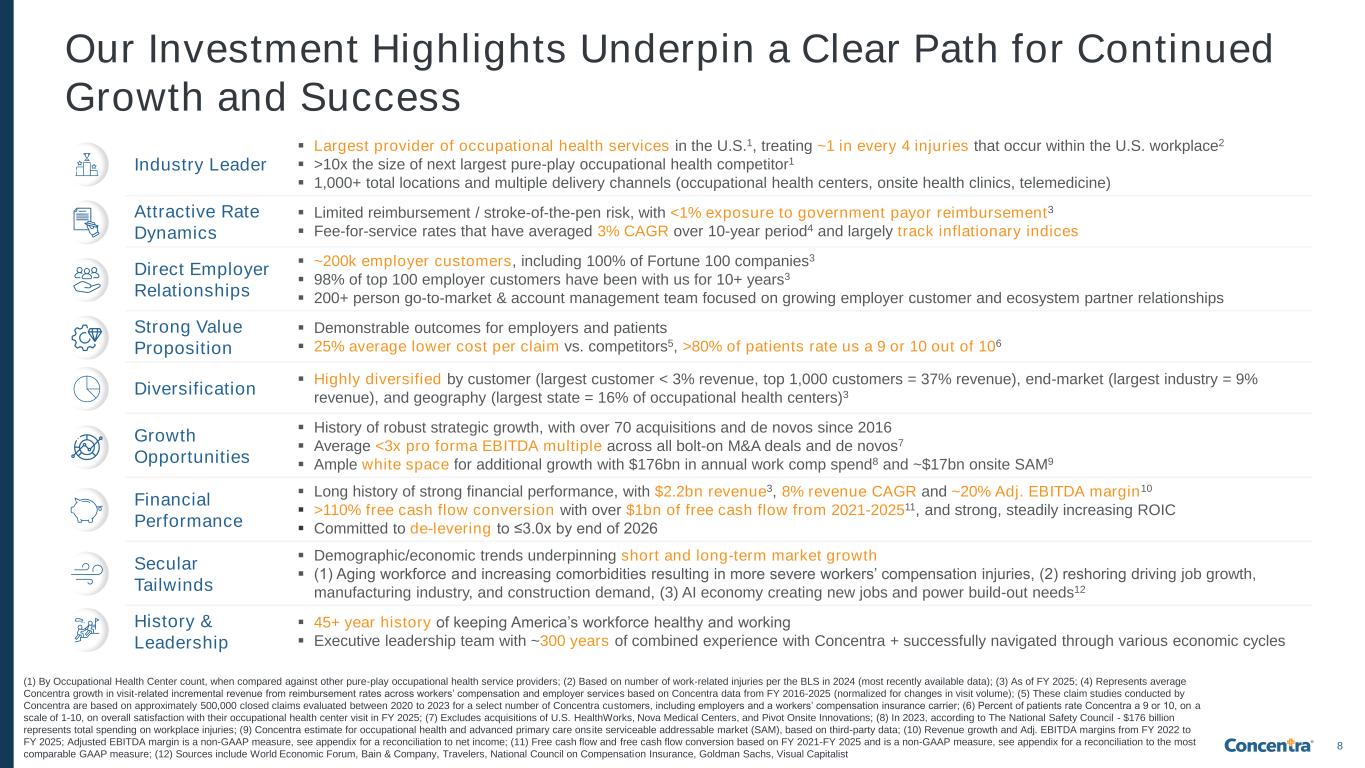
8 Our Investment Highlights Underpin a Clear Path for Continued Growth and Success (1) By Occupational Health Center count, when compared against other pure-play occupational health service providers; (2) Based on number of work-related injuries per the BLS in 2024 (most recently available data); (3) As of FY 2025; (4) Represents average Concentra growth in visit-related incremental revenue from reimbursement rates across workers’ compensation and employer services based on Concentra data from FY 2016-2025 (normalized for changes in visit volume); (5) These claim studies conducted by Concentra are based on approximately 500,000 closed claims evaluated between 2020 to 2023 for a select number of Concentra customers, including employers and a workers’ compensation insurance carrier; (6) Percent of patients rate Concentra a 9 or 10, on a scale of 1-10, on overall satisfaction with their occupational health center visit in FY 2025; (7) Excludes acquisitions of U.S. HealthWorks, Nova Medical Centers, and Pivot Onsite Innovations; (8) In 2023, according to The National Safety Council - $176 billion represents total spending on workplace injuries; (9) Concentra estimate for occupational health and advanced primary care onsite serviceable addressable market (SAM), based on third-party data; (10) Revenue growth and Adj. EBITDA margins from FY 2022 to FY 2025; Adjusted EBITDA margin is a non-GAAP measure, see appendix for a reconciliation to net income; (11) Free cash flow and free cash flow conversion based on FY 2021-FY 2025 and is a non-GAAP measure, see appendix for a reconciliation to the most comparable GAAP measure; (12) Sources include World Economic Forum, Bain & Company, Travelers, National Council on Compensation Insurance, Goldman Sachs, Visual Capitalist Industry Leader ▪ Largest provider of occupational health services in the U.S.1, treating ~1 in every 4 injuries that occur within the U.S. workplace2 ▪ >10x the size of next largest pure-play occupational health competitor1 ▪ 1,000+ total locations and multiple delivery channels (occupational health centers, onsite health clinics, telemedicine) Attractive Rate Dynamics ▪ Limited reimbursement / stroke-of-the-pen risk, with <1% exposure to government payor reimbursement3 ▪ Fee-for-service rates that have averaged 3% CAGR over 10-year period4 and largely track inflationary indices Direct Employer Relationships ▪ ~200k employer customers, including 100% of Fortune 100 companies3 ▪ 98% of top 100 employer customers have been with us for 10+ years3 ▪ 200+ person go-to-market & account management team focused on growing employer customer and ecosystem partner relationships Strong Value Proposition ▪ Demonstrable outcomes for employers and patients ▪ 25% average lower cost per claim vs. competitors5, >80% of patients rate us a 9 or 10 out of 106 Diversification ▪ Highly diversified by customer (largest customer < 3% revenue, top 1,000 customers = 37% revenue), end-market (largest industry = 9% revenue), and geography (largest state = 16% of occupational health centers)3 Growth Opportunities ▪ History of robust strategic growth, with over 70 acquisitions and de novos since 2016 ▪ Average <3x pro forma EBITDA multiple across all bolt-on M&A deals and de novos7 ▪ Ample white space for additional growth with $176bn in annual work comp spend8 and ~$17bn onsite SAM9 Financial Performance ▪ Long history of strong financial performance, with $2.2bn revenue3, 8% revenue CAGR and ~20% Adj. EBITDA margin10 ▪ >110% free cash flow conversion with over $1bn of free cash flow from 2021-202511, and strong, steadily increasing ROIC ▪ Committed to de-levering to ≤3.0x by end of 2026 Secular Tailwinds ▪ Demographic/economic trends underpinning short and long-term market growth ▪ (1) Aging workforce and increasing comorbidities resulting in more severe workers’ compensation injuries, (2) reshoring driving job growth, manufacturing industry, and construction demand, (3) AI economy creating new jobs and power build-out needs12 History & Leadership ▪ 45+ year history of keeping America’s workforce healthy and working ▪ Executive leadership team with ~300 years of combined experience with Concentra + successfully navigated through various economic cycles
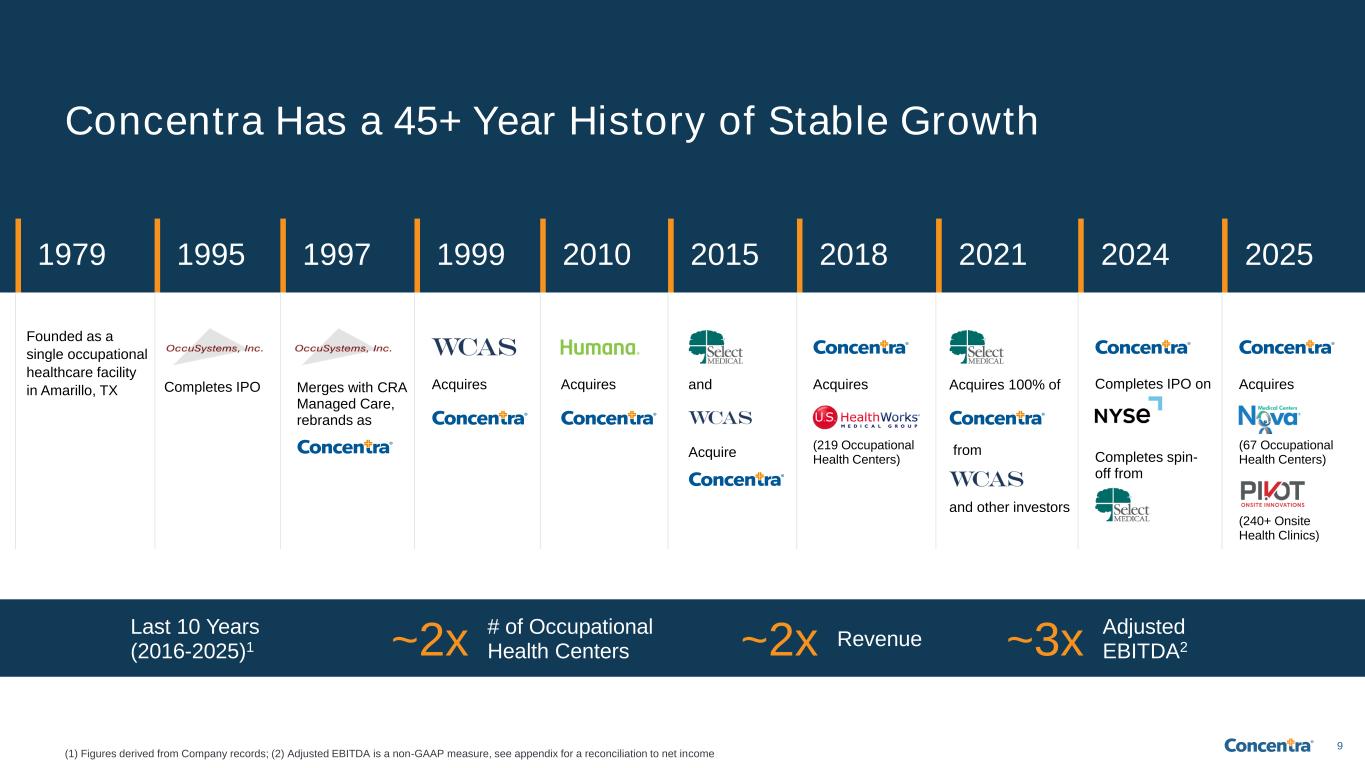
9 Concentra Has a 45+ Year History of Stable Growth 202120181995 1999 2010 Founded as a single occupational healthcare facility in Amarillo, TX 1979 Acquires (219 Occupational Health Centers) 1997 Acquires Acquires Acquire and Acquires 100% of from and other investors 2015 Completes IPO Merges with CRA Managed Care, rebrands as 2024 Completes IPO on 2025 Acquires (67 Occupational Health Centers) (240+ Onsite Health Clinics) Last 10 Years (2016-2025)1 ~2x # of Occupational Health Centers ~2x Revenue ~3x Adjusted EBITDA2 Completes spin- off from (1) Figures derived from Company records; (2) Adjusted EBITDA is a non-GAAP measure, see appendix for a reconciliation to net income
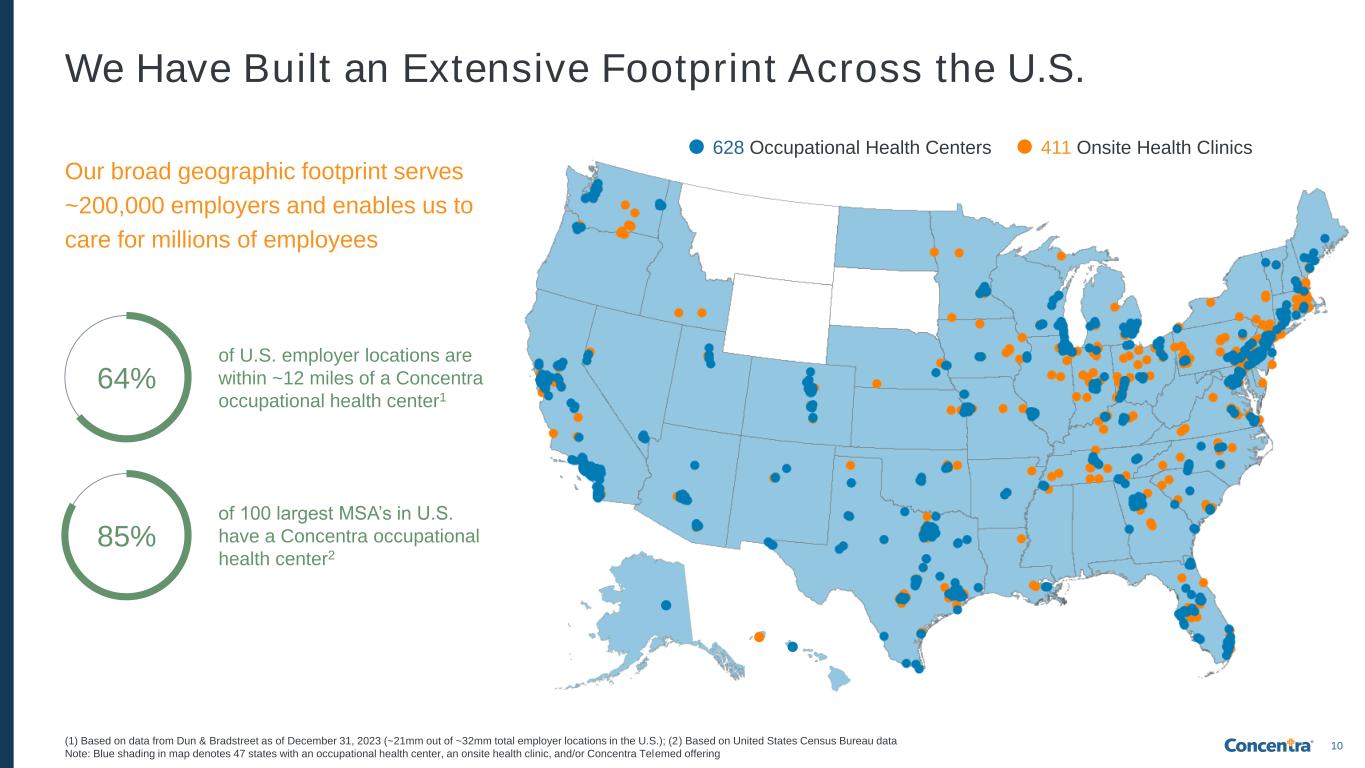
10 We Have Built an Extensive Footprint Across the U.S. Our broad geographic footprint serves ~200,000 employers and enables us to care for millions of employees 628 Occupational Health Centers 411 Onsite Health Clinics 64% 85% of U.S. employer locations are within ~12 miles of a Concentra occupational health center1 of 100 largest MSA’s in U.S. have a Concentra occupational health center2 (1) Based on data from Dun & Bradstreet as of December 31, 2023 (~21mm out of ~32mm total employer locations in the U.S.); (2) Based on United States Census Bureau data Note: Blue shading in map denotes 47 states with an occupational health center, an onsite health clinic, and/or Concentra Telemed offering
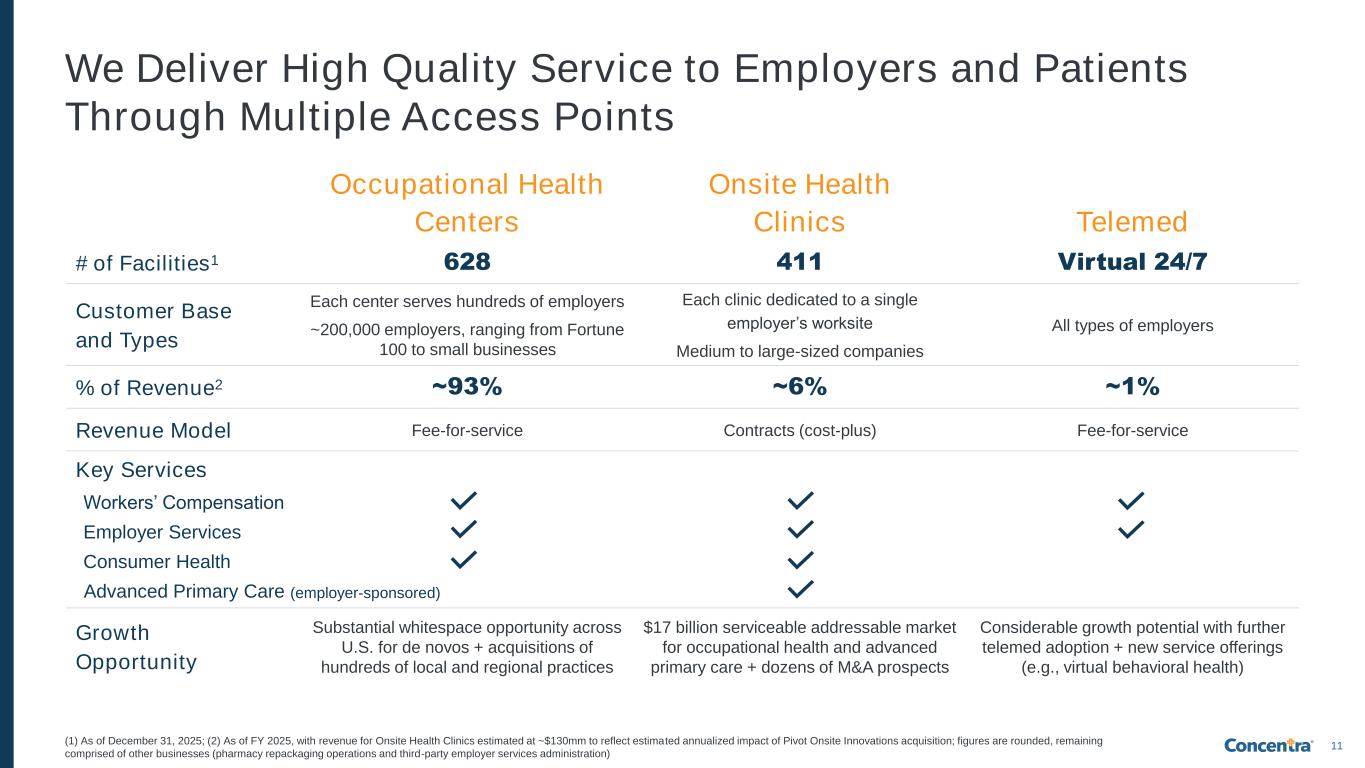
11 (1) As of March 31, 2025; (2) TTM as of March 31, 2025, figures are rounded, remaining percentage comprised of other businesses (pharmacy repackaging operations and third-party employer services administration) We Deliver High Quality Service to Employers and Patients Through Multiple Access Points Occupational Health Centers Onsite Health Clinics Telemed # of Facilities1 628 411 Virtual 24/7 Customer Base and Types Each center serves hundreds of employers ~200,000 employers, ranging from Fortune 100 to small businesses Each clinic dedicated to a single employer’s worksite Medium to large-sized companies All types of employers % of Revenue2 ~93% ~6% ~1% Revenue Model Fee-for-service Contracts (cost-plus) Fee-for-service Key Services Workers’ Compensation Employer Services Consumer Health Advanced Primary Care (employer-sponsored) Growth Opportunity Substantial whitespace opportunity across U.S. for de novos + acquisitions of hundreds of local and regional practices $17 billion serviceable addressable market for occupational health and advanced primary care + dozens of M&A prospects Considerable growth potential with further telemed adoption + new service offerings (e.g., virtual behavioral health) (1) As of December 31, 2025; (2) As of FY 2025, with revenue for Onsite Health Clinics estimated at ~$130mm to reflect estimated annualized impact of Pivot Onsite Innovations acquisition; figures are rounded, remaining comprised of other businesses (pharmacy rep ckaging operations and third-party employer services administration)
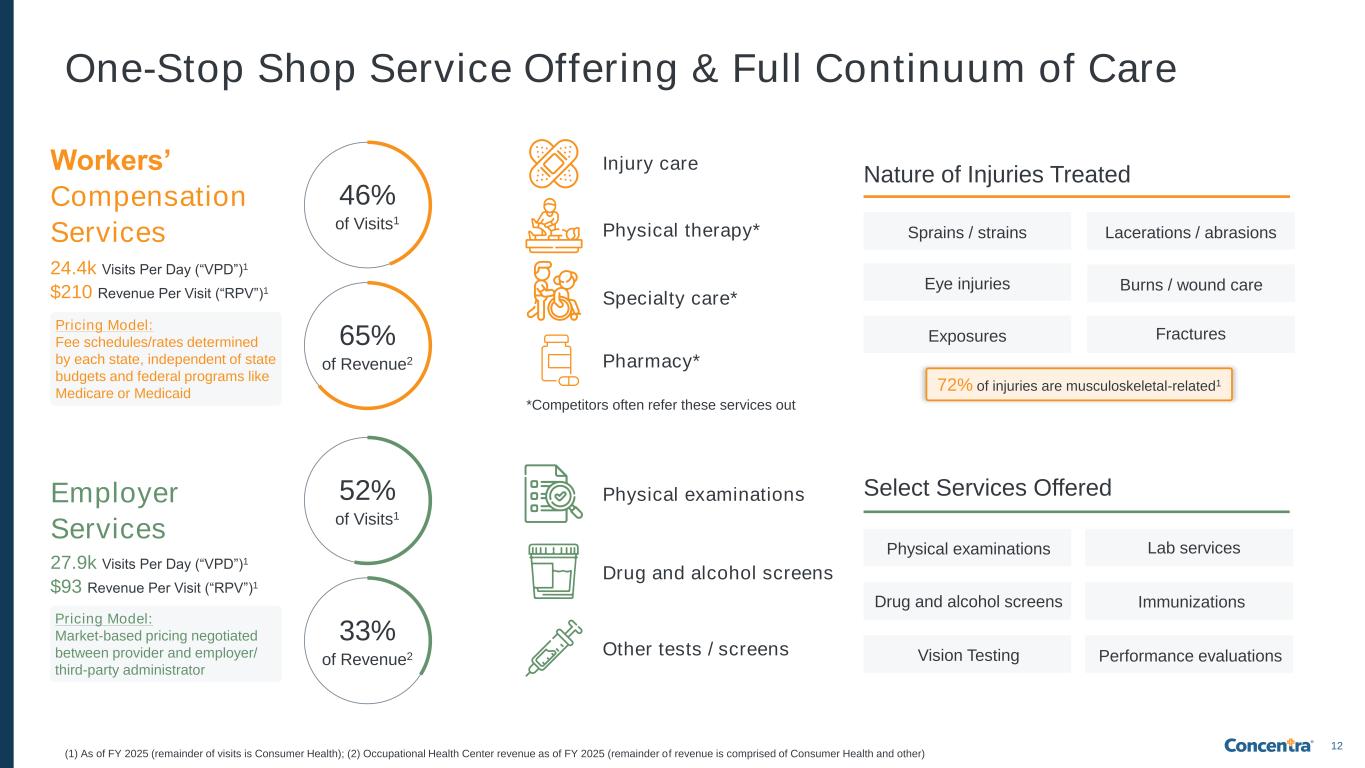
12 One-Stop Shop Service Offering & Full Continuum of Care Vision Testing Drug and alcohol screens Select Services Offered Lab services Immunizations Physical examinations Performance evaluations Physical examinations Other tests / screens Drug and alcohol screens (1) As of FY 2025 (remainder of visits is Consumer Health); (2) Occupational Health Center revenue as of FY 2025 (remainder of revenue is comprised of Consumer Health and other) Injury care Physical therapy* Specialty care* *Competitors often refer these services out Pharmacy* 65% of Revenue2 46% of Visits1 33% of Revenue2 52% of Visits1 Nature of Injuries Treated Lacerations / abrasionsSprains / strains Burns / wound careEye injuries FracturesExposures 72% of injuries are musculoskeletal-related1 Workers’ Compensation Services 24.4k Visits Per Day (“VPD”)1 $210 Revenue Per Visit (“RPV”)1 Pricing Model: Fee schedules/rates determined by each state, independent of state budgets and federal programs like Medicare or Medicaid Employer Services 27.9k Visits Per Day (“VPD”)1 $93 Revenue Per Visit (“RPV”)1 Pricing Model: Market-based pricing negotiated between provider and employer/ third-party administrator
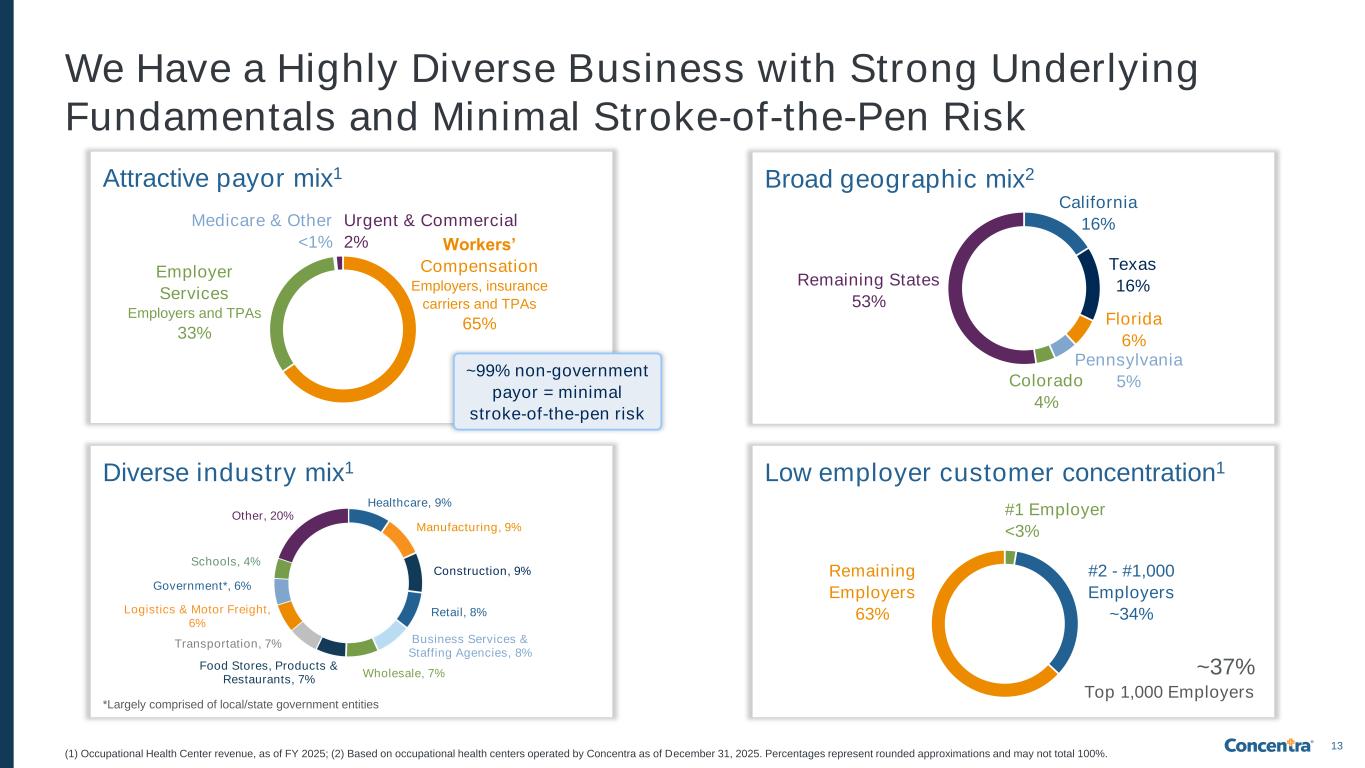
13 (1) Occupational Health Center revenue, TTM as of March 31, 2025; (2) Based on occupational health centers operated by Concentra as of March 31, 2025; (3) Excludes Nova occupational health centers. Percentages represent rounded approximations and may not total 100%. We Have a Highly Diverse Business with Strong Underlying Fundamentals and Minimal Stroke-of-the-Pen Risk (1) Occupational Health C nter revenue, as of FY 2025; (2) Based on occup tional he lth centers operated by Concentra as of December 31, 2025. Percentages represent rounded approximations and may not total 100%. Broad geographic mix2 Remaining States 53% California 16% Texas 16% Florida 6% Pennsylvania 5%Colorado 4% Attractive payor mix1 Employer Services Employers and TPAs 33% Medicare & Other <1% Workers’ Compensation Employers, insurance carriers and TPAs 65% Urgent & Commercial 2% Diverse industry mix1 Healthcare, 9% Manufacturing, 9% Construction, 9% Retail, 8% Business Services & Staffing Agencies, 8% Wholesale, 7% Food Stores, Products & Restaurants, 7% Transportation, 7% Logistics & Motor Freight, 6% Government*, 6% Schools, 4% Other, 20% Low employer customer concentration1 ~37% Top 1,000 Employers Remaining Employers 63% #2 - #1,000 Employers ~34% #1 Employer <3% *Largely comprised of local/state government entities ~99% non-government payor = minimal stroke-of-the-pen risk
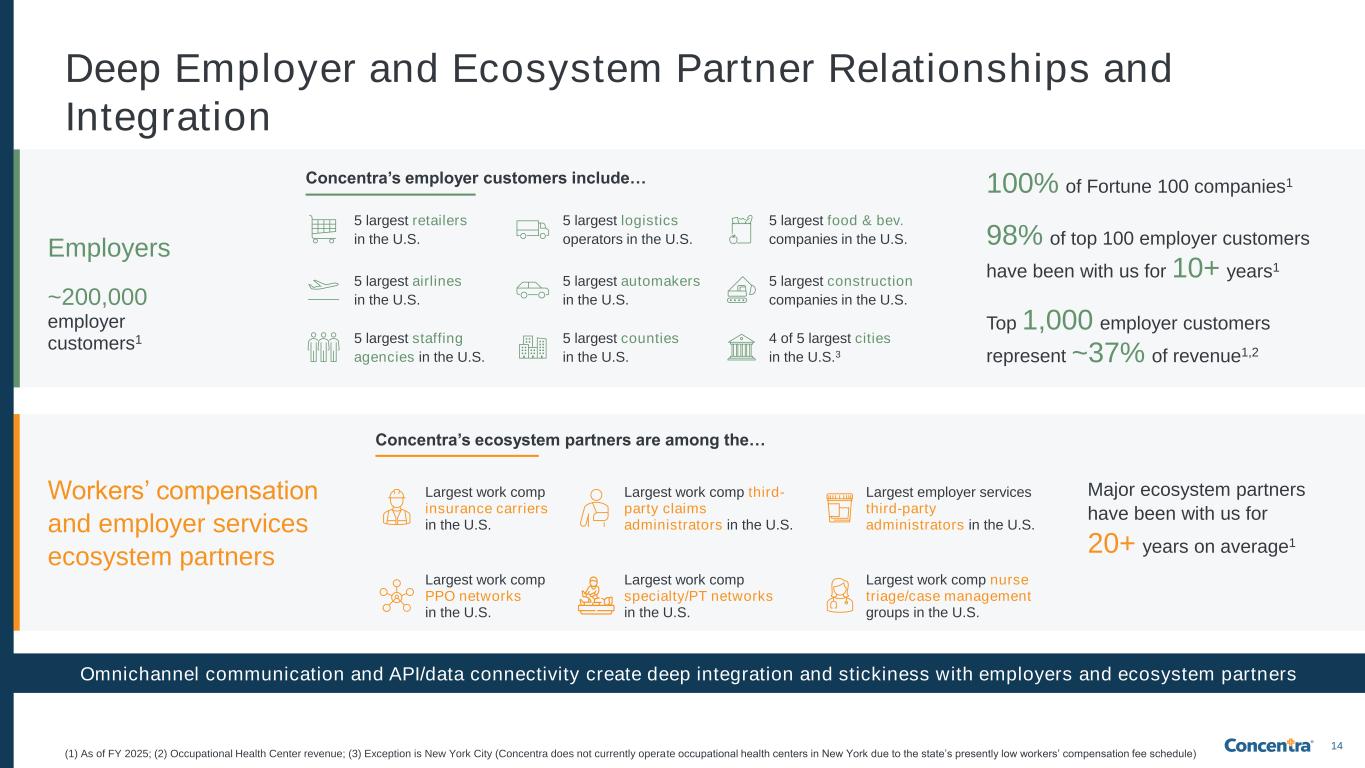
14 Employers Top 1,000 employer customers represent ~37% of revenue1,2 98% of top 100 employer customers have been with us for 10+ years1 100% of Fortune 100 companies1 Major ecosystem partners have been with us for 20+ years on average1 Workers’ compensation and employer services ecosystem partners (1) As of FY 2025; (2) Occupational Health Center revenue; (3) Exception is New York City (Concentra does not currently operate occupational health centers in New York due to the state’s presently low workers’ compensation fee schedule) Omnichannel communication and API/data connectivity create deep integration and stickiness with employers and ecosystem partners Deep Employer and Ecosystem Partner Relationships and Integration Concentra’s employer customers include… 5 largest logistics operators in the U.S. 5 largest automakers in the U.S. 5 largest counties in the U.S. 5 largest retailers in the U.S. 5 largest airlines in the U.S. 5 largest staffing agencies in the U.S. 5 largest food & bev. companies in the U.S. 5 largest construction companies in the U.S. 4 of 5 largest cities in the U.S.3 ~200,000 employer customers1 Concentra’s ecosystem partners are among the… Largest work comp insurance carriers in the U.S. Largest work comp third- party claims administrators in the U.S. Largest employer services third-party administrators in the U.S. Largest work comp PPO networks in the U.S. Largest work comp specialty/PT networks in the U.S. Largest work comp nurse triage/case management groups in the U.S.
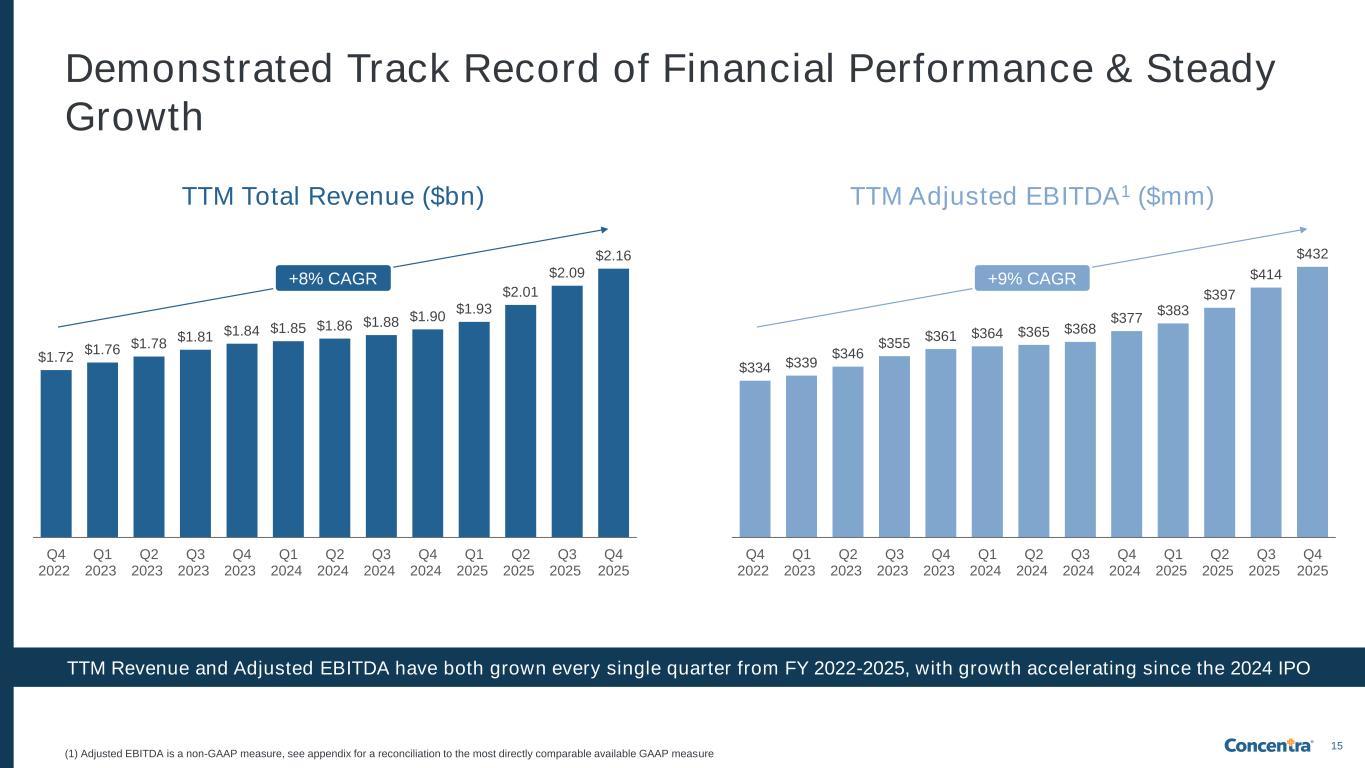
15 Demonstrated Track Record of Financial Performance & Steady Growth $1.72 $1.76 $1.78 $1.81 $1.84 $1.85 $1.86 $1.88 $1.90 $1.93 $2.01 $2.09 $2.16 Q4 2022 Q1 2023 Q2 2023 Q3 2023 Q4 2023 Q1 2024 Q2 2024 Q3 2024 Q4 2024 Q1 2025 Q2 2025 Q3 2025 Q4 2025 $334 $339 $346 $355 $361 $364 $365 $368 $377 $383 $397 $414 $432 Q4 2022 Q1 2023 Q2 2023 Q3 2023 Q4 2023 Q1 2024 Q2 2024 Q3 2024 Q4 2024 Q1 2025 Q2 2025 Q3 2025 Q4 2025 TTM Total Revenue ($bn) TTM Adjusted EBITDA1 ($mm) +8% CAGR +9% CAGR (1) Adjusted EBITDA is a non-GAAP measure, see appendix for a reconciliation to the most directly comparable available GAAP measure TTM Revenue and Adjusted EBITDA have both grown every single quarter from FY 2022-2025, with growth accelerating since the 2024 IPO
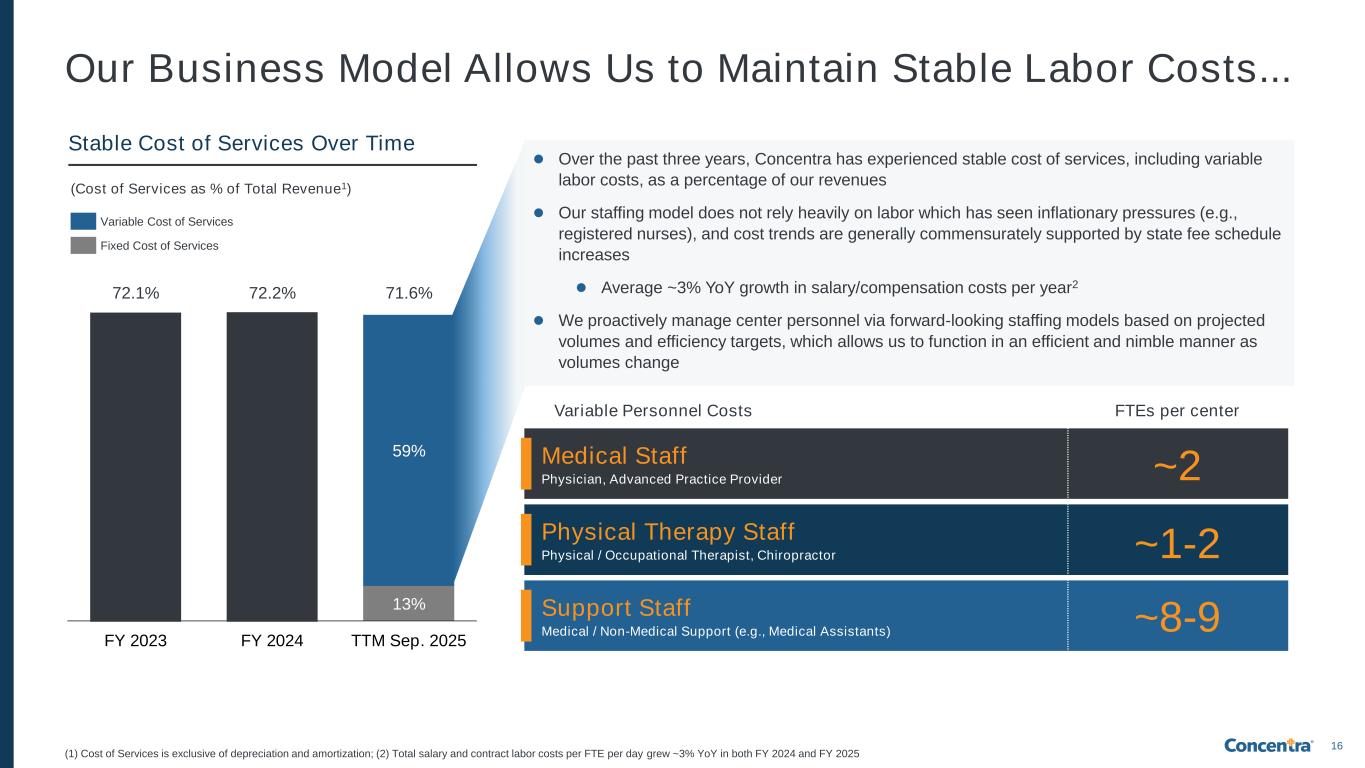
16 Stable Cost of Services Over Time ⚫ Over the past three years, Concentra has experienced stable cost of services, including variable labor costs, as a percentage of our revenues ⚫ Our staffing model does not rely heavily on labor which has seen inflationary pressures (e.g., registered nurses), and cost trends are generally commensurately supported by state fee schedule increases ⚫ Average ~3% YoY growth in salary/compensation costs per year2 ⚫ We proactively manage center personnel via forward-looking staffing models based on projected volumes and efficiency targets, which allows us to function in an efficient and nimble manner as volumes change 13% 59% FY 2023 FY 2024 TTM Sep. 2025 (Cost of Services as % of Total Revenue1) Medical Staff Physician, Advanced Practice Provider Physical Therapy Staff Physical / Occupational Therapist, Chiropractor Support Staff Medical / Non-Medical Support (e.g., Medical Assistants) Variable Personnel Costs FTEs per center ~2 ~1-2 ~8-9 71.6% Fixed Cost of Services Variable Cost of Services (1) Cost of Services is exclusive of depreciation and amortization; (2) Total salary and contract labor costs per FTE per day grew ~3% YoY in both FY 2024 and FY 2025 72.2%72.1% Our Business Model Allows Us to Maintain Stable Labor Costs...
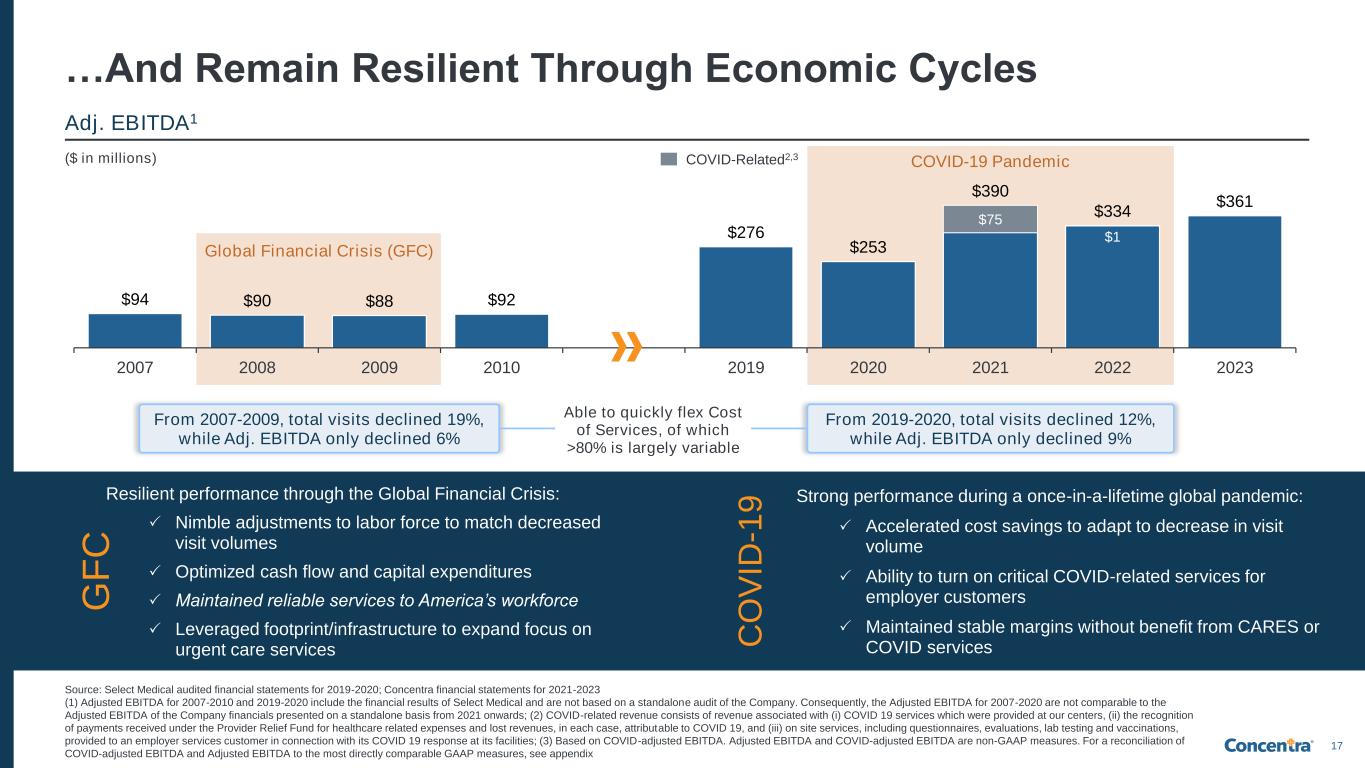
17 COVID-19 Pandemic Global Financial Crisis (GFC) $75 $1 $94 $90 $88 $92 $276 $253 $390 $334 $361 2007 2008 2009 2010 2019 2020 2021 2022 2023 G F C Resilient performance through the Global Financial Crisis: Nimble adjustments to labor force to match decreased visit volumes Optimized cash flow and capital expenditures Maintained reliable services to America’s workforce Leveraged footprint/infrastructure to expand focus on urgent care services C O V ID -1 9 Strong performance during a once-in-a-lifetime global pandemic: Accelerated cost savings to adapt to decrease in visit volume Ability to turn on critical COVID-related services for employer customers Maintained stable margins without benefit from CARES or COVID services Source: Select Medical audited financial statements for 2019-2020; Concentra financial statements for 2021-2023 (1) Adjusted EBITDA for 2007-2010 and 2019-2020 include the financial results of Select Medical and are not based on a standalone audit of the Company. Consequently, the Adjusted EBITDA for 2007-2020 are not comparable to the Adjusted EBITDA of the Company financials presented on a standalone basis from 2021 onwards; (2) COVID-related revenue consists of revenue associated with (i) COVID 19 services which were provided at our centers, (ii) the recognition of payments received under the Provider Relief Fund for healthcare related expenses and lost revenues, in each case, attributable to COVID 19, and (iii) on site services, including questionnaires, evaluations, lab testing and vaccinations, provided to an employer services customer in connection with its COVID 19 response at its facilities; (3) Based on COVID-adjusted EBITDA. Adjusted EBITDA and COVID-adjusted EBITDA are non-GAAP measures. For a reconciliation of COVID-adjusted EBITDA and Adjusted EBITDA to the most directly comparable GAAP measures, see appendix Adj. EBITDA1 ($ in millions) COVID-Related2,3 From 2007-2009, total visits declined 19%, while Adj. EBITDA only declined 6% From 2019-2020, total visits declined 12%, while Adj. EBITDA only declined 9% …And Remain Resilient Through Economic Cycles Able to quickly flex Cost of Services, of which >80% is largely variable
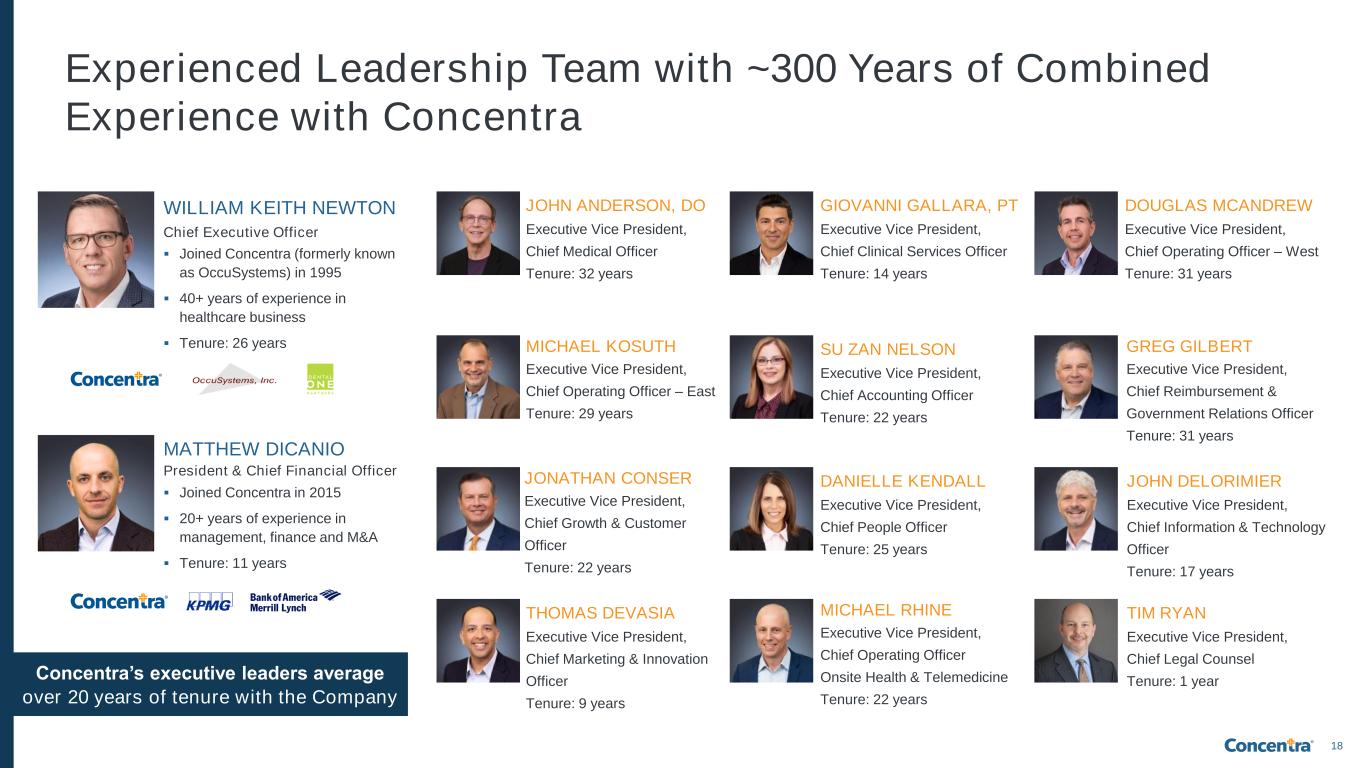
18 Experienced Leadership Team with ~300 Years of Combined Experience with Concentra MATTHEW DICANIO President & Chief Financial Officer ▪ Joined Concentra in 2015 ▪ 20+ years of experience in management, finance and M&A ▪ Tenure: 11 years WILLIAM KEITH NEWTON Chief Executive Officer ▪ Joined Concentra (formerly known as OccuSystems) in 1995 ▪ 40+ years of experience in healthcare business ▪ Tenure: 26 years DANIELLE KENDALL Executive Vice President, Chief People Officer Tenure: 25 years GIOVANNI GALLARA, PT Executive Vice President, Chief Clinical Services Officer Tenure: 14 years SU ZAN NELSON Executive Vice President, Chief Accounting Officer Tenure: 22 years MICHAEL RHINE Executive Vice President, Chief Operating Officer Onsite Health & Telemedicine Tenure: 22 years JONATHAN CONSER Executive Vice President, Chief Growth & Customer Officer Tenure: 22 years JOHN ANDERSON, DO Executive Vice President, Chief Medical Officer Tenure: 32 years MICHAEL KOSUTH Executive Vice President, Chief Operating Officer – East Tenure: 29 years THOMAS DEVASIA Executive Vice President, Chief Marketing & Innovation Officer Tenure: 9 years JOHN DELORIMIER Executive Vice President, Chief Information & Technology Officer Tenure: 17 years DOUGLAS MCANDREW Executive Vice President, Chief Operating Officer – West Tenure: 31 years GREG GILBERT Executive Vice President, Chief Reimbursement & Government Relations Officer Tenure: 31 years TIM RYAN Executive Vice President, Chief Legal Counsel Tenure: 1 yearConcentra’s executive leaders average over 20 years of tenure with the Company

Value Proposition
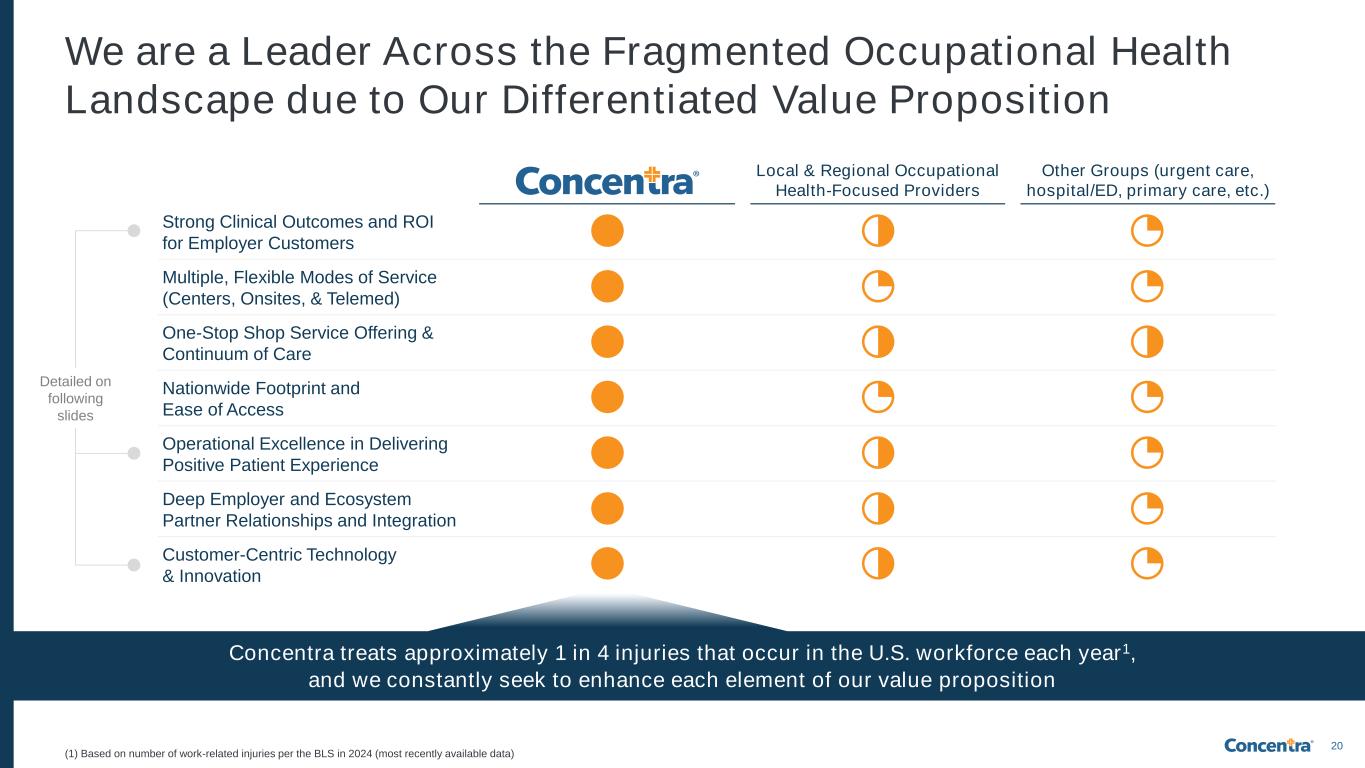
20 We are a Leader Across the Fragmented Occupational Health Landscape due to Our Differentiated Value Proposition Local & Regional Occupational Health-Focused Providers Other Groups (urgent care, hospital/ED, primary care, etc.) Strong Clinical Outcomes and ROI for Employer Customers Multiple, Flexible Modes of Service (Centers, Onsites, & Telemed) One-Stop Shop Service Offering & Continuum of Care Nationwide Footprint and Ease of Access Operational Excellence in Delivering Positive Patient Experience Deep Employer and Ecosystem Partner Relationships and Integration Customer-Centric Technology & Innovation Concentra treats approximately 1 in 4 injuries that occur in the U.S. workforce each year1, and we constantly seek to enhance each element of our value proposition Detailed on following slides (1) Based on number of work-related injuries per the BLS in 2024 (most recently available data)
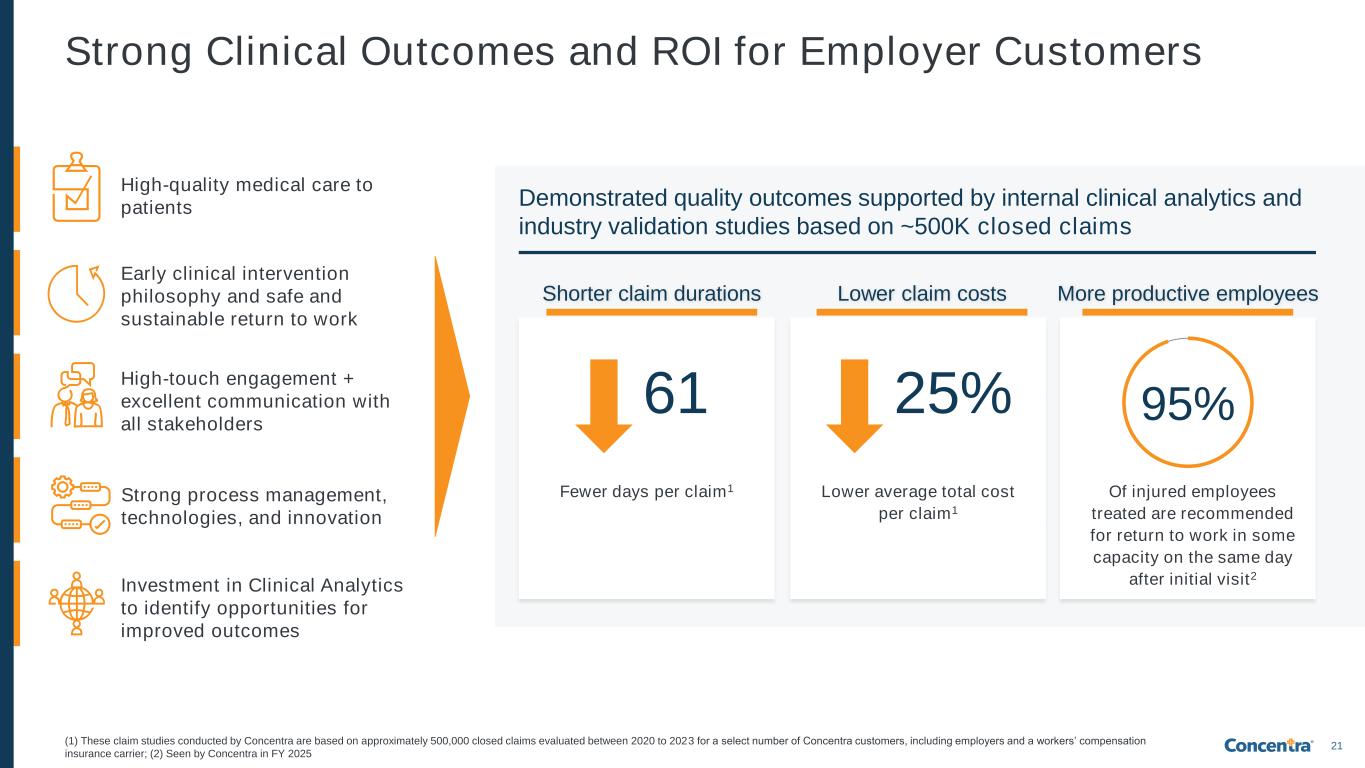
21(1) These claim studies conducted by Concentra are based on approximately 500,000 closed claims evaluated between 2020 to 2023 for a select number of Concentra customers, including employers and a workers’ compensation insurance carrier; (2) Seen by Concentra in FY 2025 Lower claim costsShorter claim durations More productive employees Demonstrated quality outcomes supported by internal clinical analytics and industry validation studies based on ~500K closed claims Fewer days per claim1 Lower average total cost per claim1 Of injured employees treated are recommended for return to work in some capacity on the same day after initial visit2 61 25% 95% High-quality medical care to patients Investment in Clinical Analytics to identify opportunities for improved outcomes High-touch engagement + excellent communication with all stakeholders Early clinical intervention philosophy and safe and sustainable return to work Strong process management, technologies, and innovation Strong Clinical Outcomes and ROI for Employer Customers
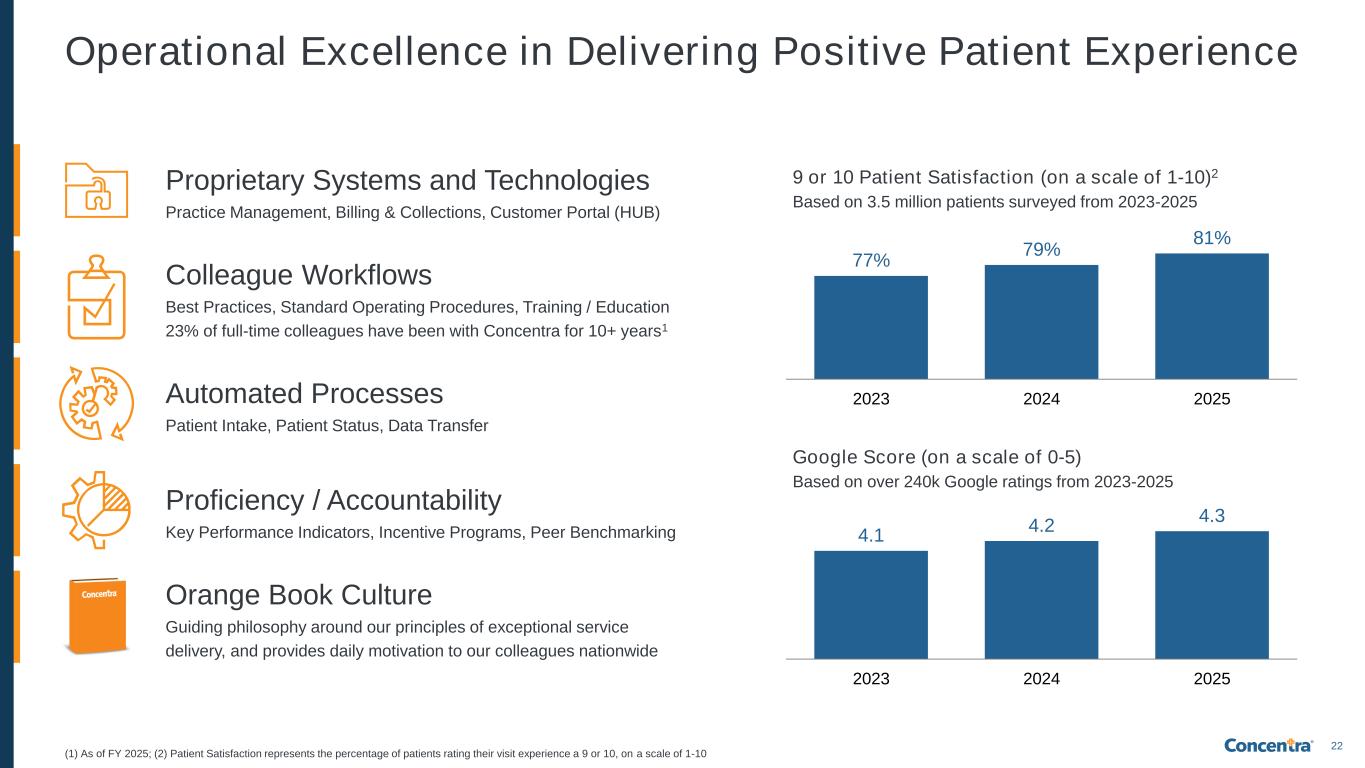
22 (1) As of FY 2025; (2) Patient Satisfaction represents the percentage of patients rating their visit experience a 9 or 10, on a scale of 1-10 77% 79% 81% 2023 2024 2025 9 or 10 Patient Satisfaction (on a scale of 1-10)2 Based on 3.5 million patients surveyed from 2023-2025 Proprietary Systems and Technologies Practice Management, Billing & Collections, Customer Portal (HUB) Automated Processes Patient Intake, Patient Status, Data Transfer Colleague Workflows Best Practices, Standard Operating Procedures, Training / Education 23% of full-time colleagues have been with Concentra for 10+ years1 Proficiency / Accountability Key Performance Indicators, Incentive Programs, Peer Benchmarking Orange Book Culture Guiding philosophy around our principles of exceptional service delivery, and provides daily motivation to our colleagues nationwide 4.1 4.2 4.3 2023 2024 2025 Google Score (on a scale of 0-5) Based on over 240k Google ratings from 2023-2025 Operational Excellence in Delivering Positive Patient Experience
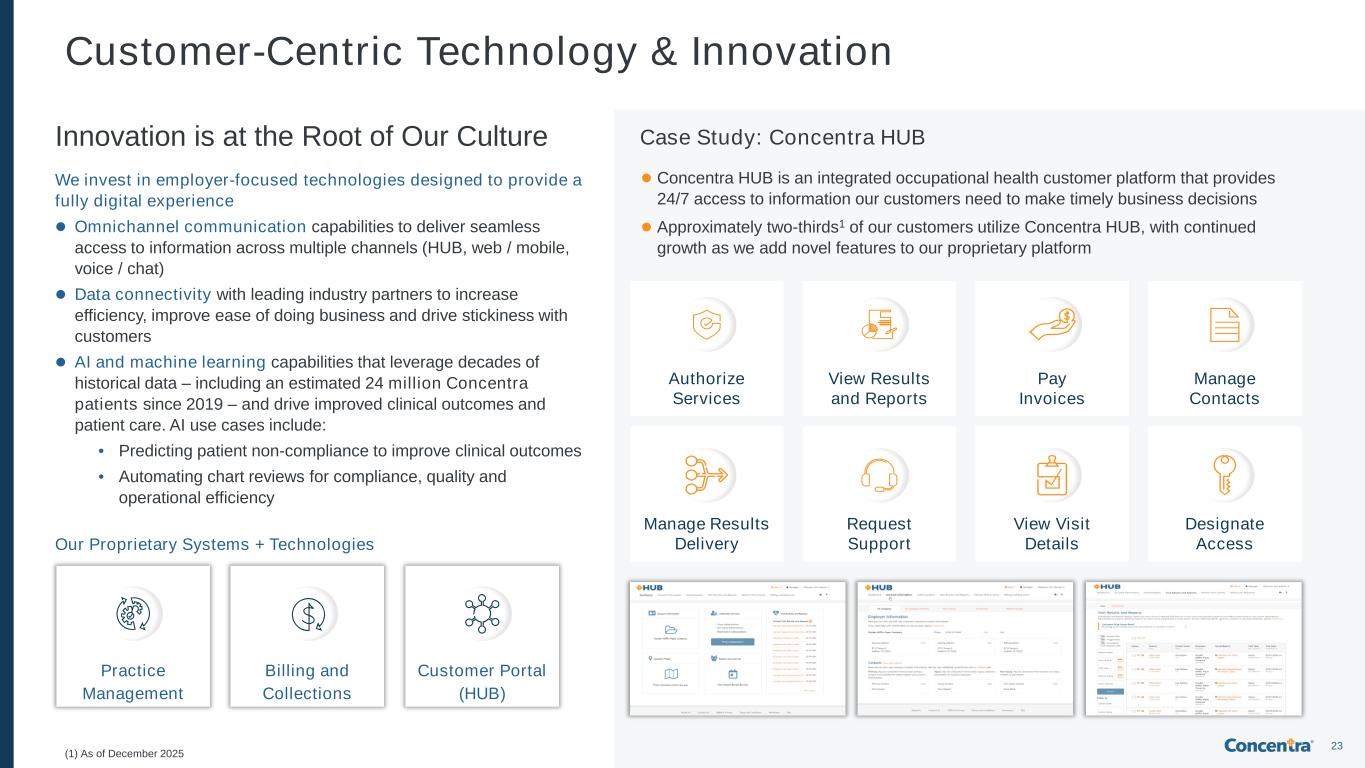
23 We invest in employer-focused technologies designed to provide a fully digital experience ⚫ Omnichannel communication capabilities to deliver seamless access to information across multiple channels (HUB, web / mobile, voice / chat) ⚫ Data connectivity with leading industry partners to increase efficiency, improve ease of doing business and drive stickiness with customers ⚫ AI and machine learning capabilities that leverage decades of historical data – including an estimated 24 million Concentra patients since 2019 – and drive improved clinical outcomes and patient care. AI use cases include: Predicting patient non-compliance to improve clinical outcomes Automating chart reviews for compliance, quality and operational efficiency ⚫ Concentra HUB is an integrated occupational health customer platform that provides 24/7 access to information our customers need to make timely business decisions ⚫ Approximately two-thirds1 of our customers utilize Concentra HUB, with continued growth as we add novel features to our proprietary platform Innovation is at the Root of Our Culture Case Study: Concentra HUB View Results and Reports Request Support Manage Contacts Designate Access Pay Invoices View Visit Details Authorize Services Manage Results Delivery Practice Management Our Proprietary Systems + Technologies Billing and Collections Customer Portal (HUB) (1) As of December 2025 Customer-Centric Technology & Innovation
Facilities & People
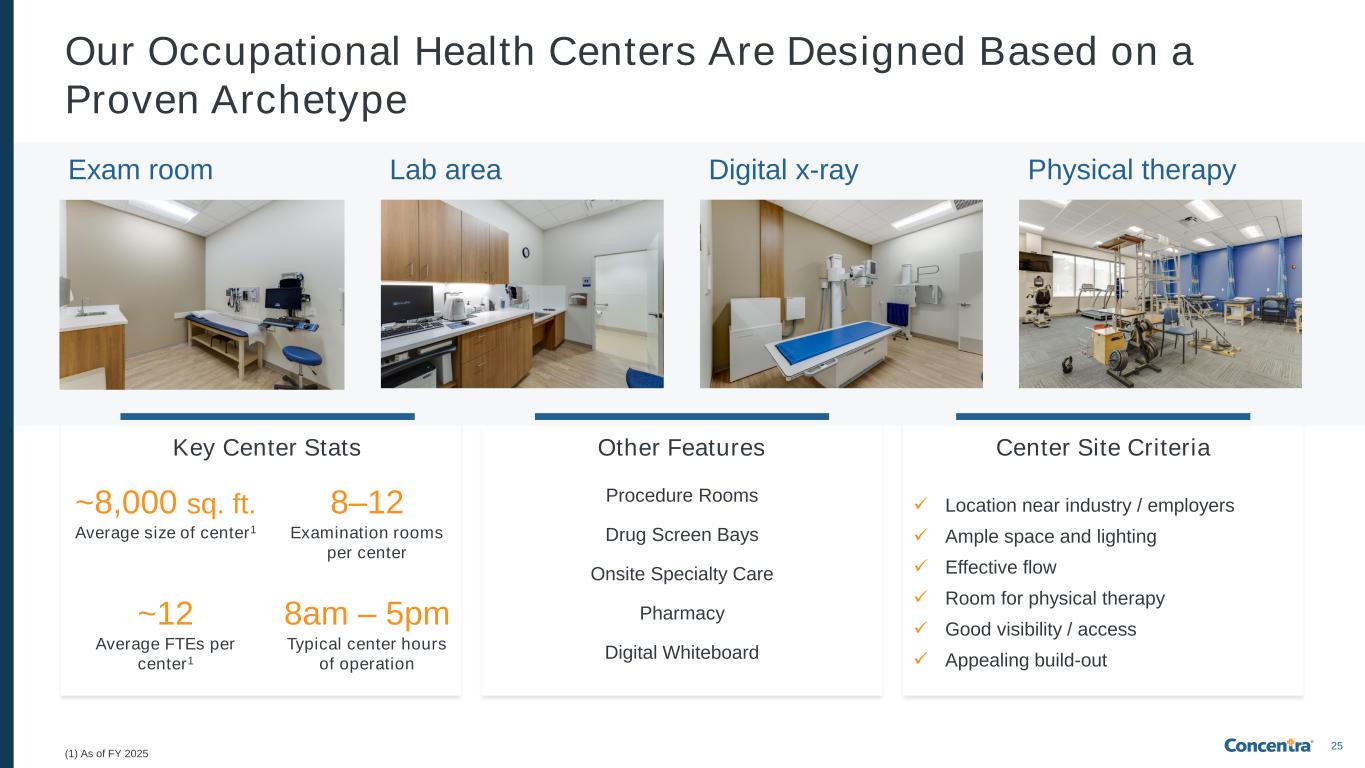
25 ~8,000 sq. ft. Average size of center1 ~12 Average FTEs per center1 8–12 Examination rooms per center Procedure Rooms Drug Screen Bays Onsite Specialty Care Pharmacy Digital Whiteboard Key Center Stats Other Features Exam room Lab area Digital x-ray Physical therapy Center Site Criteria ✓ Location near industry / employers ✓ Ample space and lighting ✓ Effective flow ✓ Room for physical therapy ✓ Good visibility / access ✓ Appealing build-out (1) As of FY 2025 8am – 5pm Typical center hours of operation Our Occupational Health Centers Are Designed Based on a Proven Archetype
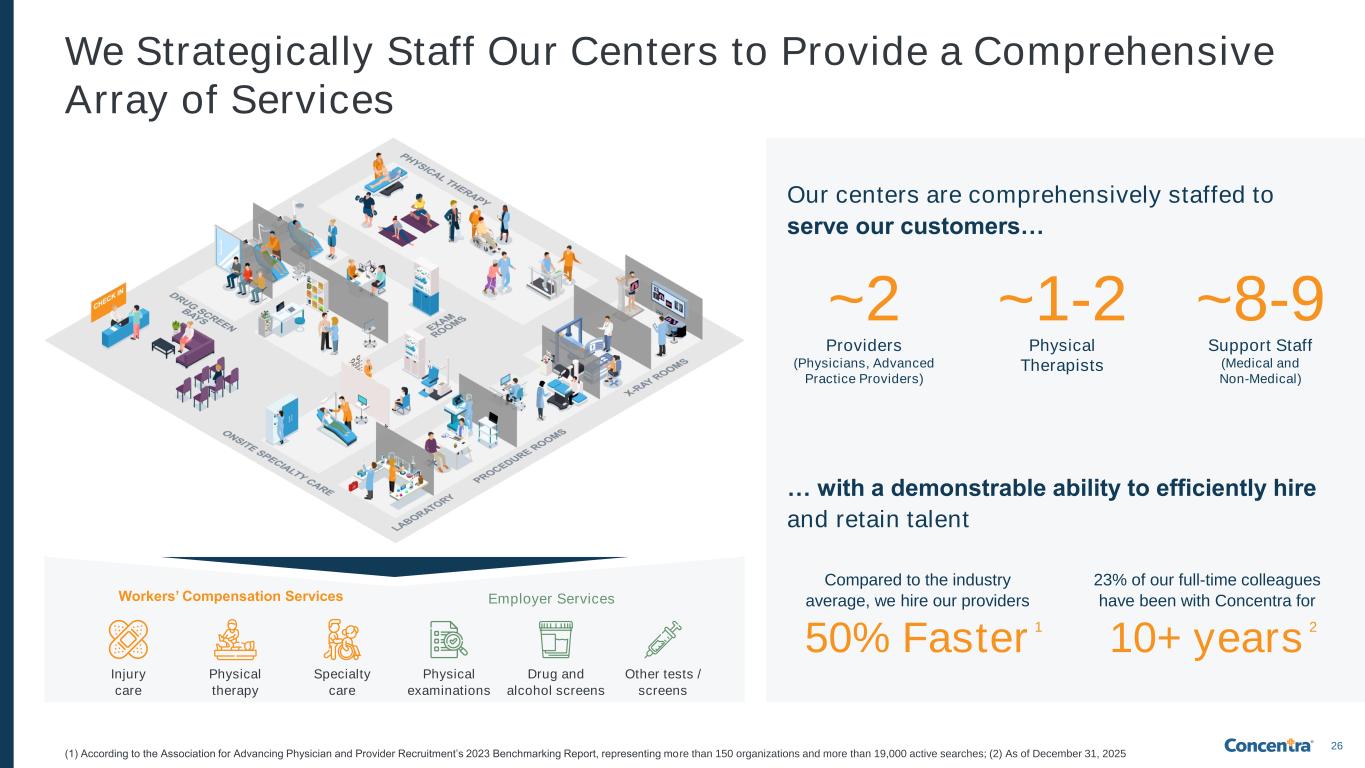
26 (1) According to the Association for Advancing Physician and Provider Recruitment’s 2023 Benchmarking Report, representing more than 150 organizations and more than 19,000 active searches; (2) As of December 31, 2025 Injury care Physical therapy Physical examinations Other tests / screens Drug and alcohol screens Specialty care Workers’ Compensation Services Employer Services ~2 Providers (Physicians, Advanced Practice Providers) ~1-2 Physical Therapists ~8-9 Support Staff (Medical and Non-Medical) Our centers are comprehensively staffed to serve our customers… 23% of our full-time colleagues have been with Concentra for 10+ years Compared to the industry average, we hire our providers 50% Faster … with a demonstrable ability to efficiently hire and retain talent 1 2 We Strategically Staff Our Centers to Provide a Comprehensive Array of Services
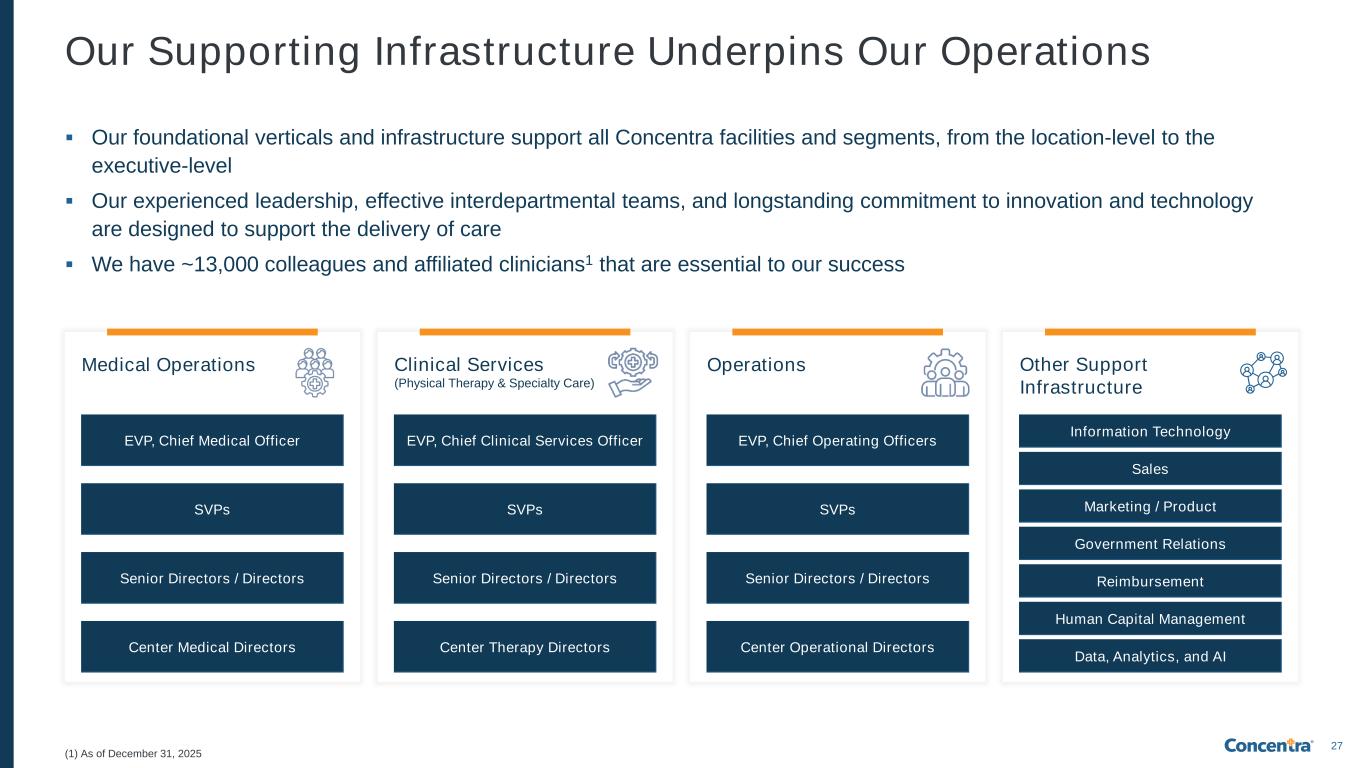
27 ▪ Our foundational verticals and infrastructure support all Concentra facilities and segments, from the location-level to the executive-level ▪ Our experienced leadership, effective interdepartmental teams, and longstanding commitment to innovation and technology are designed to support the delivery of care ▪ We have ~13,000 colleagues and affiliated clinicians1 that are essential to our success Medical Operations Clinical Services (Physical Therapy & Specialty Care) Operations Other Support Infrastructure EVP, Chief Medical Officer Information Technology Sales Marketing / Product Government Relations Reimbursement Human Capital Management SVPs Senior Directors / Directors Center Medical Directors EVP, Chief Clinical Services Officer SVPs Senior Directors / Directors Center Therapy Directors EVP, Chief Operating Officers SVPs Senior Directors / Directors Center Operational Directors (1) As of December 31, 2025 Our Supporting Infrastructure Underpins Our Operations Data, Analytics, and AI

Industry Overview
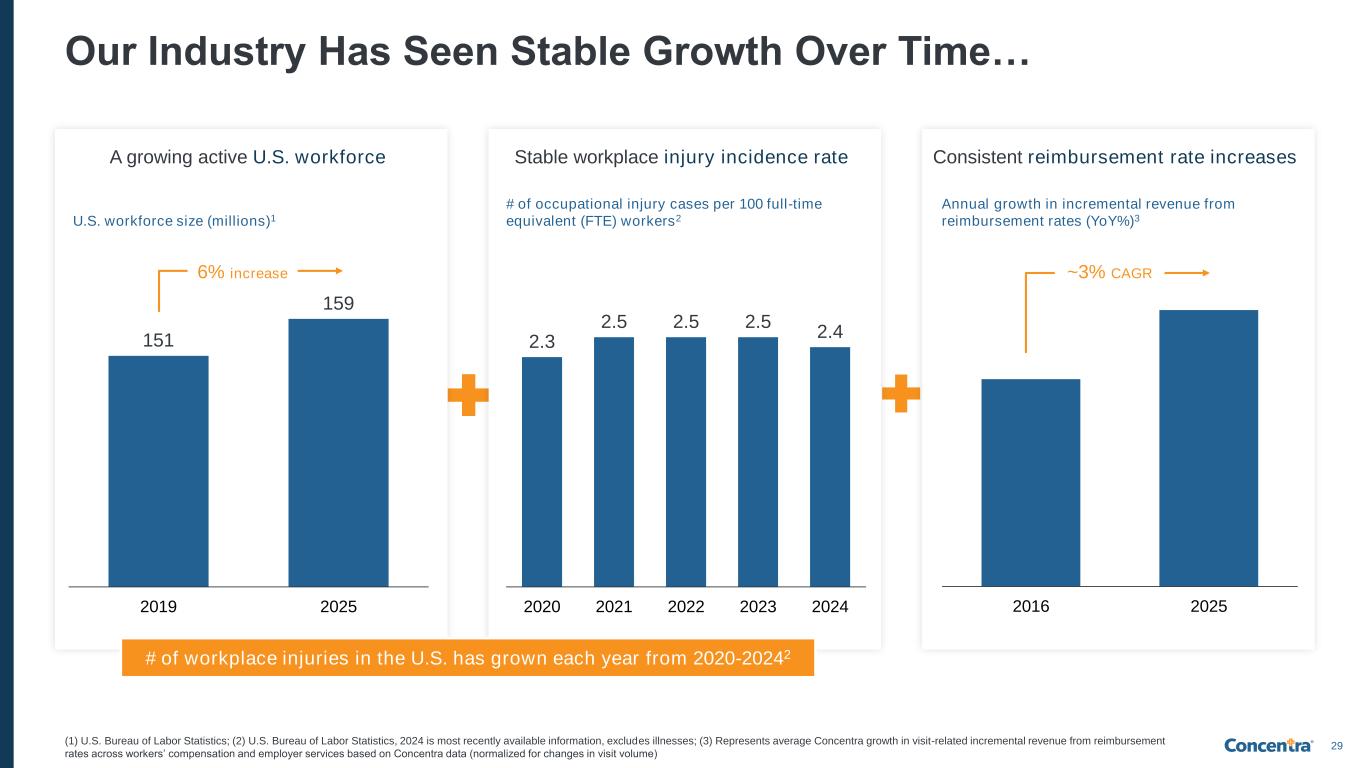
29 Our Industry Has Seen Stable Growth Over Time… Stable workplace injury incidence rate (1) U.S. Bureau of Labor Statistics; (2) U.S. Bureau of Labor Statistics, 2024 is most recently available information, excludes illnesses; (3) Represents average Concentra growth in visit-related incremental revenue from reimbursement rates across workers’ compensation and employer services based on Concentra data (normalized for changes in visit volume) Consistent reimbursement rate increasesA growing active U.S. workforce 151 159 2019 2025 6% increase 2016 2025 ~3% CAGR U.S. workforce size (millions)1 # of occupational injury cases per 100 full-time equivalent (FTE) workers2 Annual growth in incremental revenue from reimbursement rates (YoY%)3 2.3 2.5 2.5 2.5 2.4 2020 2021 2022 2023 2024 # of workplace injuries in the U.S. has grown each year from 2020-20242
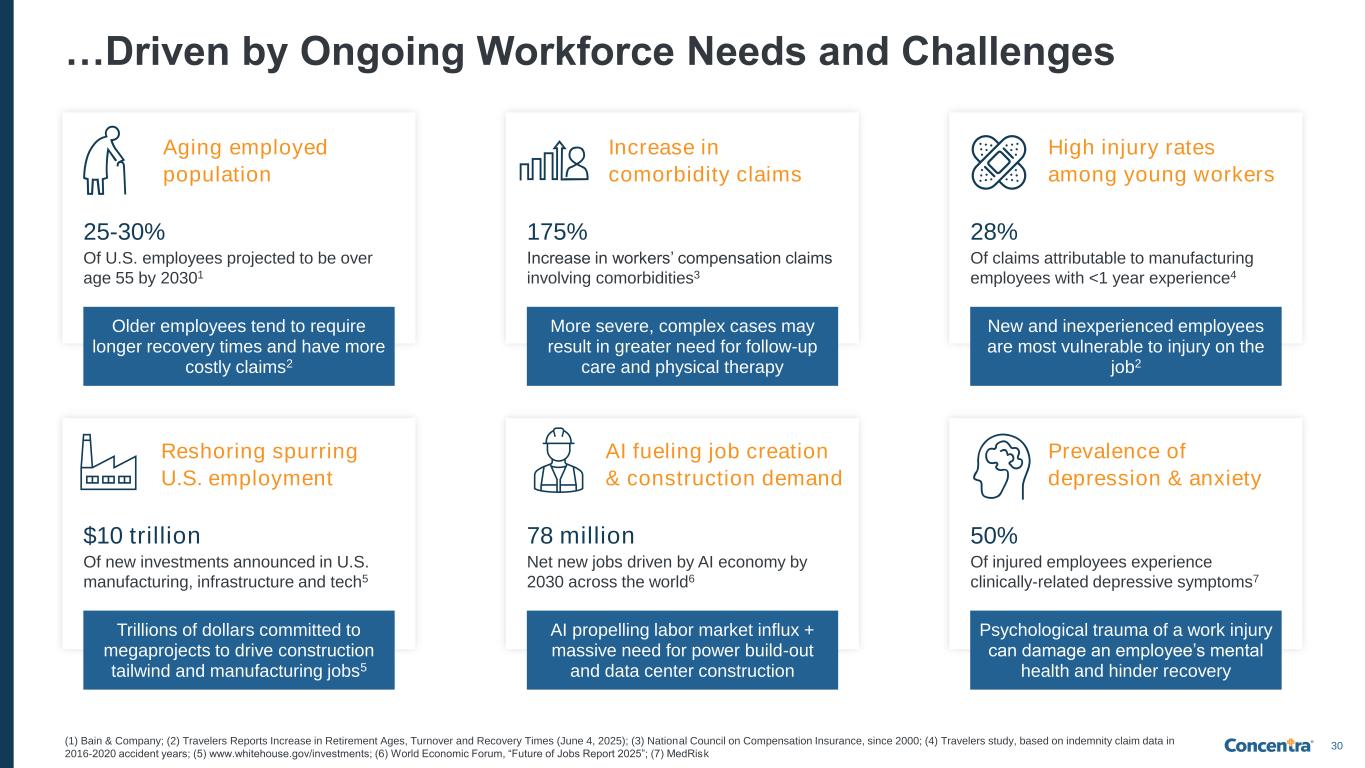
30 …Driven by Ongoing Workforce Needs and Challenges (1) Bain & Company; (2) Travelers Reports Increase in Retirement Ages, Turnover and Recovery Times (June 4, 2025); (3) National Council on Compensation Insurance, since 2000; (4) Travelers study, based on indemnity claim data in 2016-2020 accident years; (5) www.whitehouse.gov/investments; (6) World Economic Forum, “Future of Jobs Report 2025”; (7) MedRisk 25-30% Of U.S. employees projected to be over age 55 by 20301 Aging employed population Older employees tend to require longer recovery times and have more costly claims2 175% Increase in workers’ compensation claims involving comorbidities3 Increase in comorbidity claims More severe, complex cases may result in greater need for follow-up care and physical therapy 28% Of claims attributable to manufacturing employees with <1 year experience4 High injury rates among young workers New and inexperienced employees are most vulnerable to injury on the job2 50% Of injured employees experience clinically-related depressive symptoms7 Prevalence of depression & anxiety Psychological trauma of a work injury can damage an employee’s mental health and hinder recovery $10 trillion Of new investments announced in U.S. manufacturing, infrastructure and tech5 Reshoring spurring U.S. employment Trillions of dollars committed to megaprojects to drive construction tailwind and manufacturing jobs5 78 million Net new jobs driven by AI economy by 2030 across the world6 AI fueling job creation & construction demand AI propelling labor market influx + massive need for power build-out and data center construction
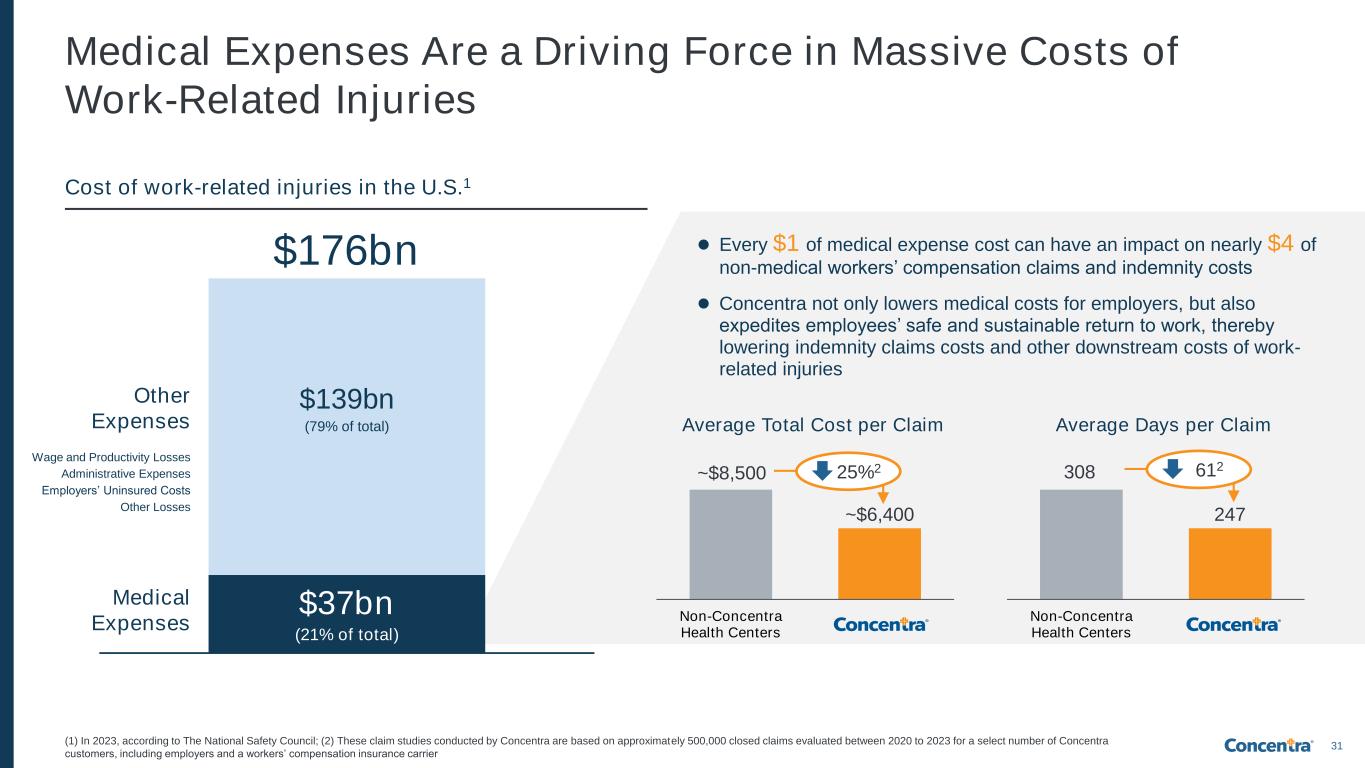
31 Medical Expenses Are a Driving Force in Massive Costs of Work-Related Injuries ⚫ Every $1 of medical expense cost can have an impact on nearly $4 of non-medical workers’ compensation claims and indemnity costs ⚫ Concentra not only lowers medical costs for employers, but also expedites employees’ safe and sustainable return to work, thereby lowering indemnity claims costs and other downstream costs of work- related injuries $176bn Cost of work-related injuries in the U.S.1 $139bn (79% of total) $37bn (21% of total) Medical Expenses Other Expenses Wage and Productivity Losses Administrative Expenses Employers’ Uninsured Costs Other Losses Non-Concentra Health Centers Average Total Cost per Claim ~$8,500 ~$6,400 25%2 Non-Concentra Health Centers Average Days per Claim 612308 247 (1) In 2023, according to The National Safety Council; (2) These claim studies conducted by Concentra are based on approximately 500,000 closed claims evaluated between 2020 to 2023 for a select number of Concentra customers, including employers and a workers’ compensation insurance carrier
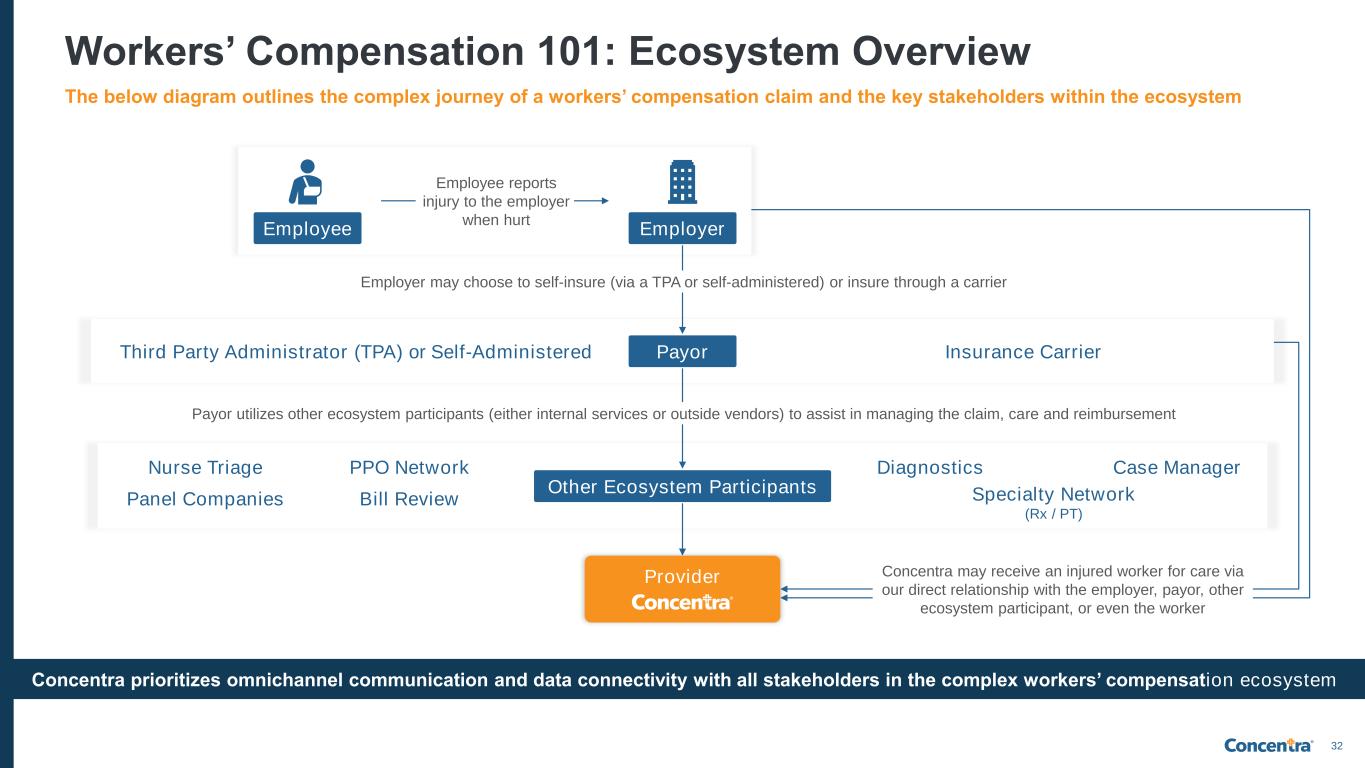
32 Workers’ Compensation 101: Ecosystem Overview The below diagram outlines the complex journey of a workers’ compensation claim and the key stakeholders within the ecosystem Concentra prioritizes omnichannel communication and data connectivity with all stakeholders in the complex workers’ compensation ecosystem Employee reports injury to the employer when hurt Employee Employer PayorThird Party Administrator (TPA) or Self-Administered Insurance Carrier Other Ecosystem Participants Employer may choose to self-insure (via a TPA or self-administered) or insure through a carrier Bill Review Specialty Network (Rx / PT) Case ManagerNurse Triage PPO Network Diagnostics Provider Payor utilizes other ecosystem participants (either internal services or outside vendors) to assist in managing the claim, care and reimbursement Concentra may receive an injured worker for care via our direct relationship with the employer, payor, other ecosystem participant, or even the worker Panel Companies
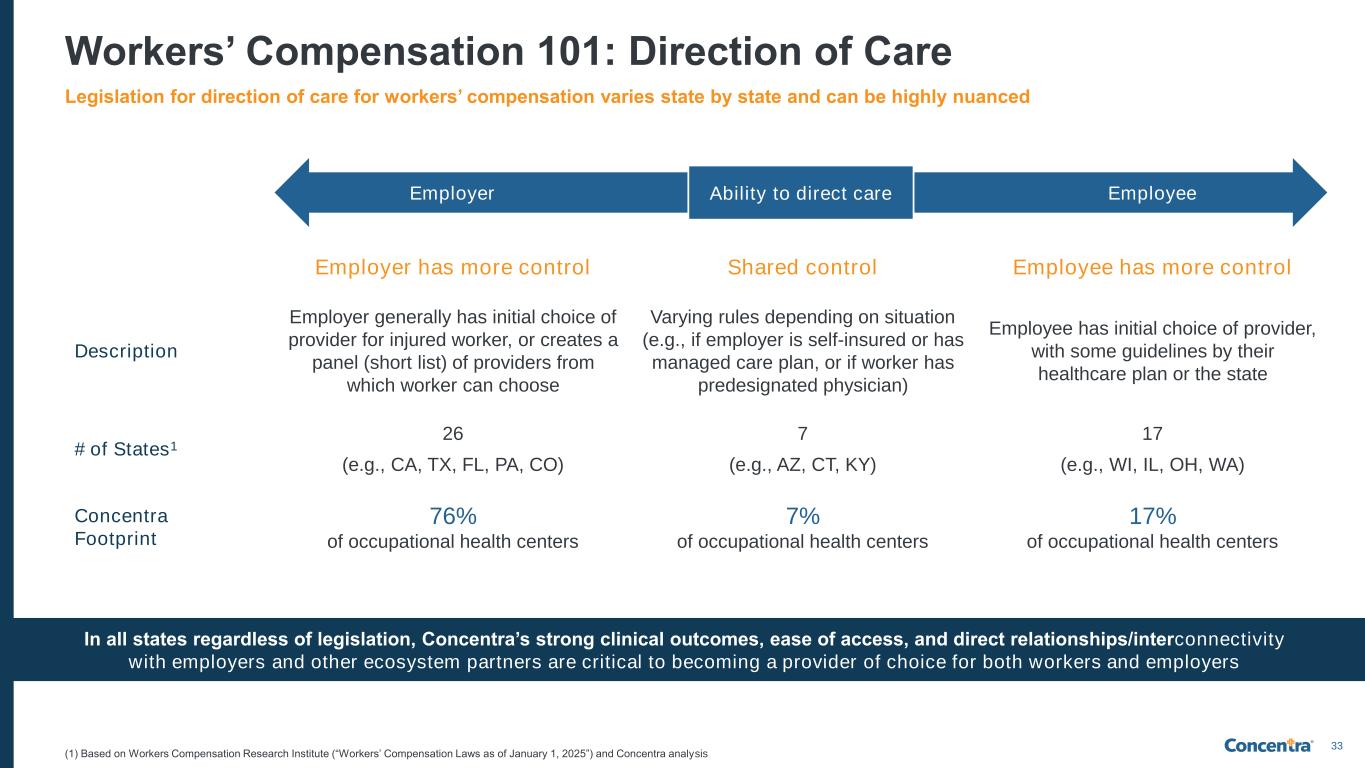
33 Workers’ Compensation 101: Direction of Care Legislation for direction of care for workers’ compensation varies state by state and can be highly nuanced Employer has more control Shared control Employee has more control Description Employer generally has initial choice of provider for injured worker, or creates a panel (short list) of providers from which worker can choose Varying rules depending on situation (e.g., if employer is self-insured or has managed care plan, or if worker has predesignated physician) Employee has initial choice of provider, with some guidelines by their healthcare plan or the state # of States1 26 (e.g., CA, TX, FL, PA, CO) 7 (e.g., AZ, CT, KY) 17 (e.g., WI, IL, OH, WA) Concentra Footprint 76% of occupational health centers 7% of occupational health centers 17% of occupational health centers Ability to direct careEmployer Employee (1) Based on Workers Compensation Research Institute (“Workers’ Compensation Laws as of January 1, 2025”) and Concentra analysis In all states regardless of legislation, Concentra’s strong clinical outcomes, ease of access, and direct relationships/interconnectivity with employers and other ecosystem partners are critical to becoming a provider of choice for both workers and employers
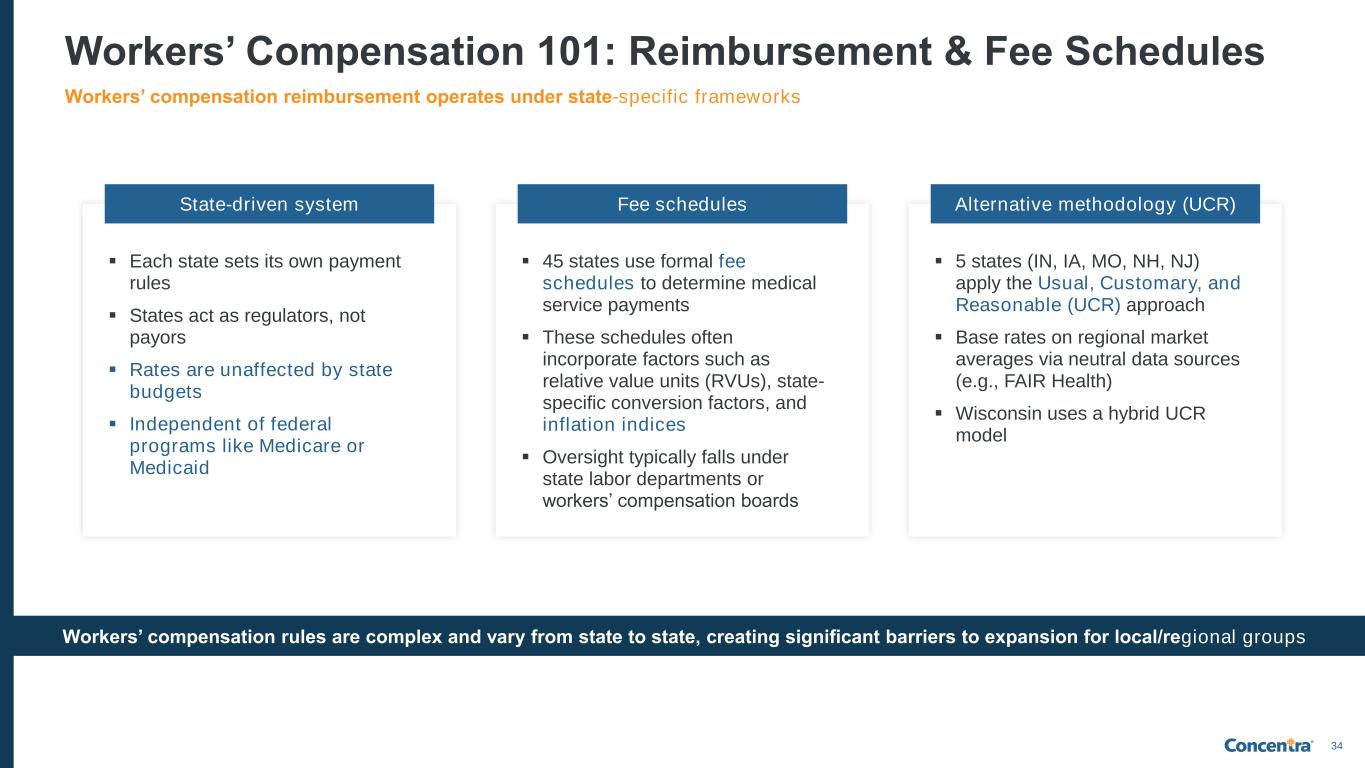
34 Workers’ Compensation 101: Reimbursement & Fee Schedules Workers’ compensation rules are complex and vary from state to state, creating significant barriers to expansion for local/regional groups Workers’ compensation reimbursement operates under state-specific frameworks State-driven system ▪ Each state sets its own payment rules ▪ States act as regulators, not payors ▪ Rates are unaffected by state budgets ▪ Independent of federal programs like Medicare or Medicaid Fee schedules ▪ 45 states use formal fee schedules to determine medical service payments ▪ These schedules often incorporate factors such as relative value units (RVUs), state- specific conversion factors, and inflation indices ▪ Oversight typically falls under state labor departments or workers’ compensation boards Alternative methodology (UCR) ▪ 5 states (IN, IA, MO, NH, NJ) apply the Usual, Customary, and Reasonable (UCR) approach ▪ Base rates on regional market averages via neutral data sources (e.g., FAIR Health) ▪ Wisconsin uses a hybrid UCR model
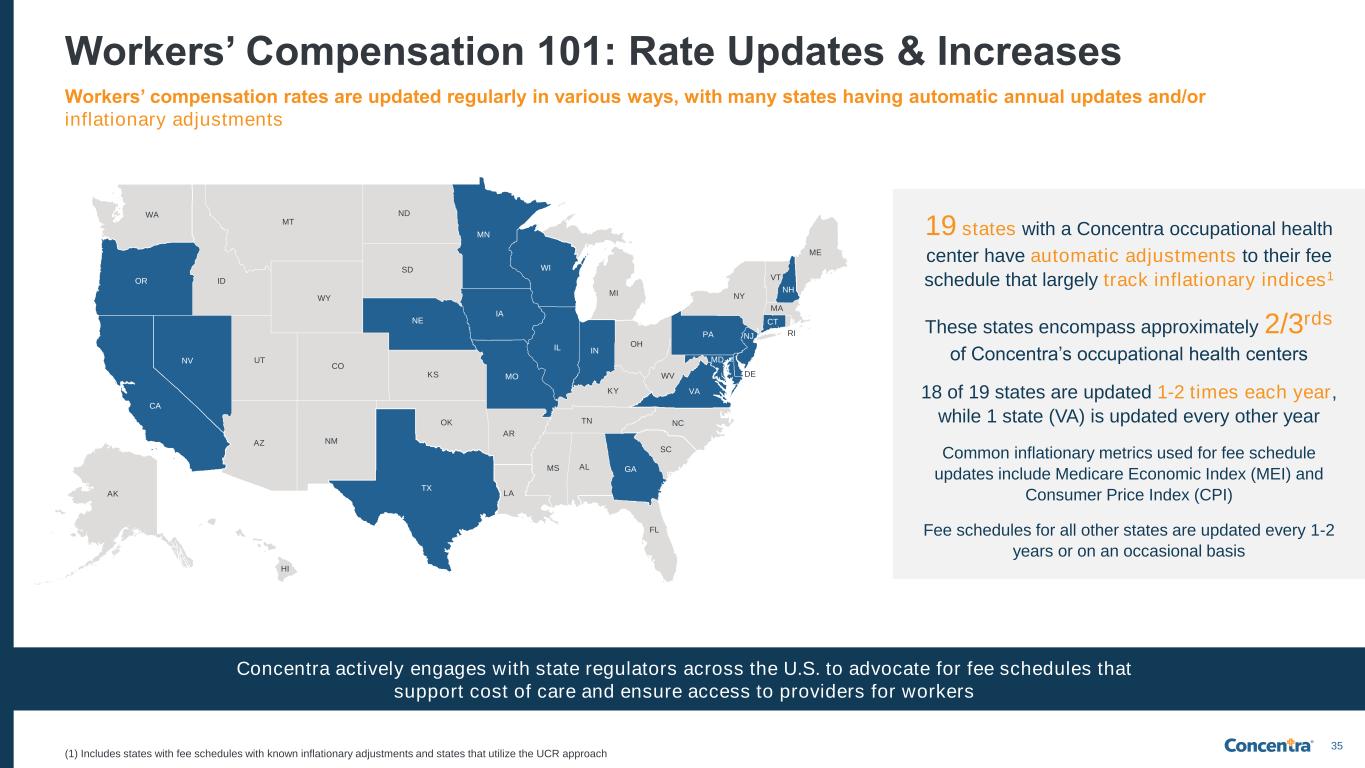
35 Workers’ Compensation 101: Rate Updates & Increases Workers’ compensation rates are updated regularly in various ways, with many states having automatic annual updates and/or inflationary adjustments Concentra actively engages with state regulators across the U.S. to advocate for fee schedules that support cost of care and ensure access to providers for workers 19 states with a Concentra occupational health center have automatic adjustments to their fee schedule that largely track inflationary indices1 These states encompass approximately 2/3rds of Concentra’s occupational health centers 18 of 19 states are updated 1-2 times each year, while 1 state (VA) is updated every other year Common inflationary metrics used for fee schedule updates include Medicare Economic Index (MEI) and Consumer Price Index (CPI) Fee schedules for all other states are updated every 1-2 years or on an occasional basis TX MT CA ID NV AZ OR IL NM CO WY MN SD IA ND UT KS NE WA WI OK MI MO NY PA FL IN AL GA AR LA NC VA TN KY OH MS ME SC WV VT NH MA CT NJ MD DE RI AK HI (1) Includes states with fee schedules with known inflationary adjustments and states that utilize the UCR approach
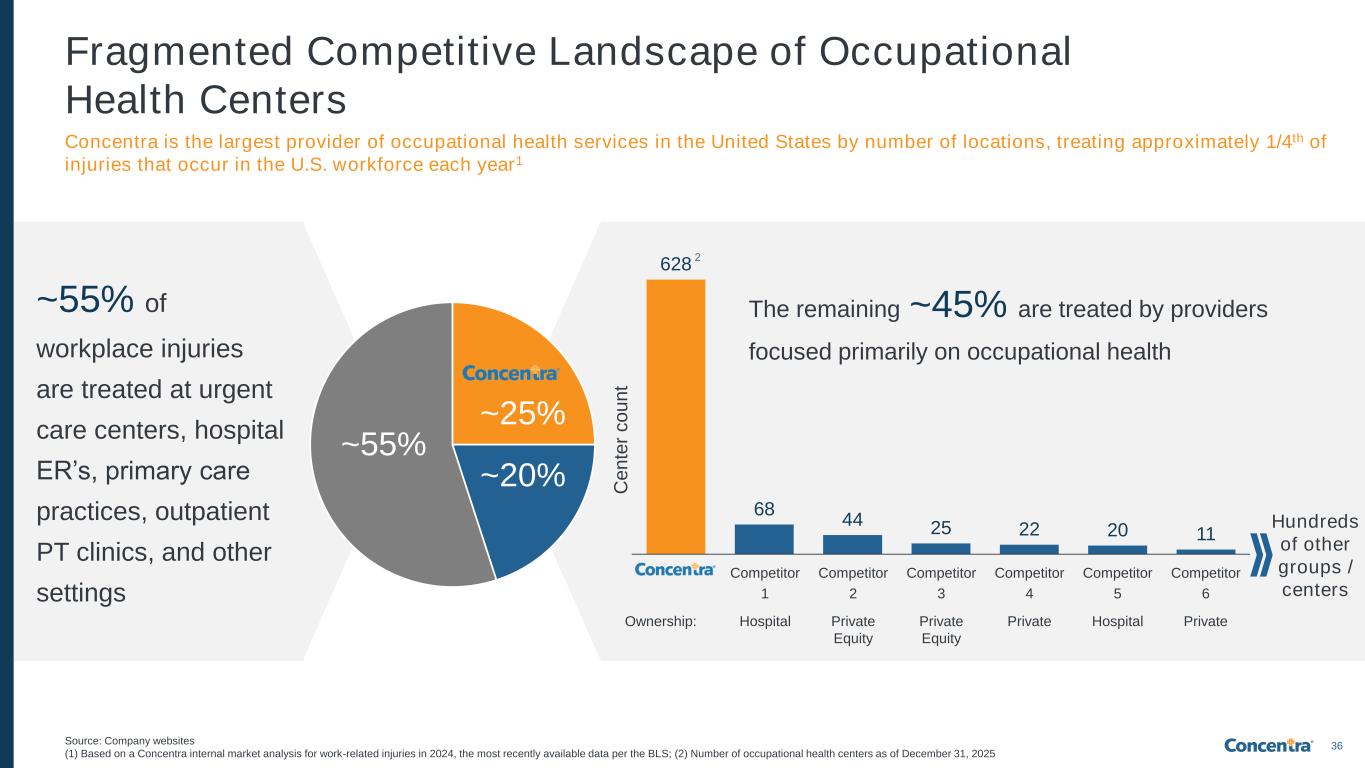
36 Fragmented Competitive Landscape of Occupational Health Centers 628 68 44 25 22 20 11 Competitor 1 Competitor 2 Competitor 3 Competitor 4 Competitor 5 Competitor 6 2 C e n te r c o u n t ~55% of workplace injuries are treated at urgent care centers, hospital ER’s, primary care practices, outpatient PT clinics, and other settings The remaining ~45% are treated by providers focused primarily on occupational health Hundreds of other groups / centers Source: Company websites (1) Based on a Concentra internal market analysis for work-related injuries in 2024, the most recently available data per the BLS; (2) Number of occupational health centers as of December 31, 2025 Concentra is the largest provider of occupational health services in the United States by number of locations, treating approximately 1/4th of injuries that occur in the U.S. workforce each year1 ~25% ~20% ~55% Ownership: Hospital Private Equity Private Equity Private Hospital Private

Growth Strategy
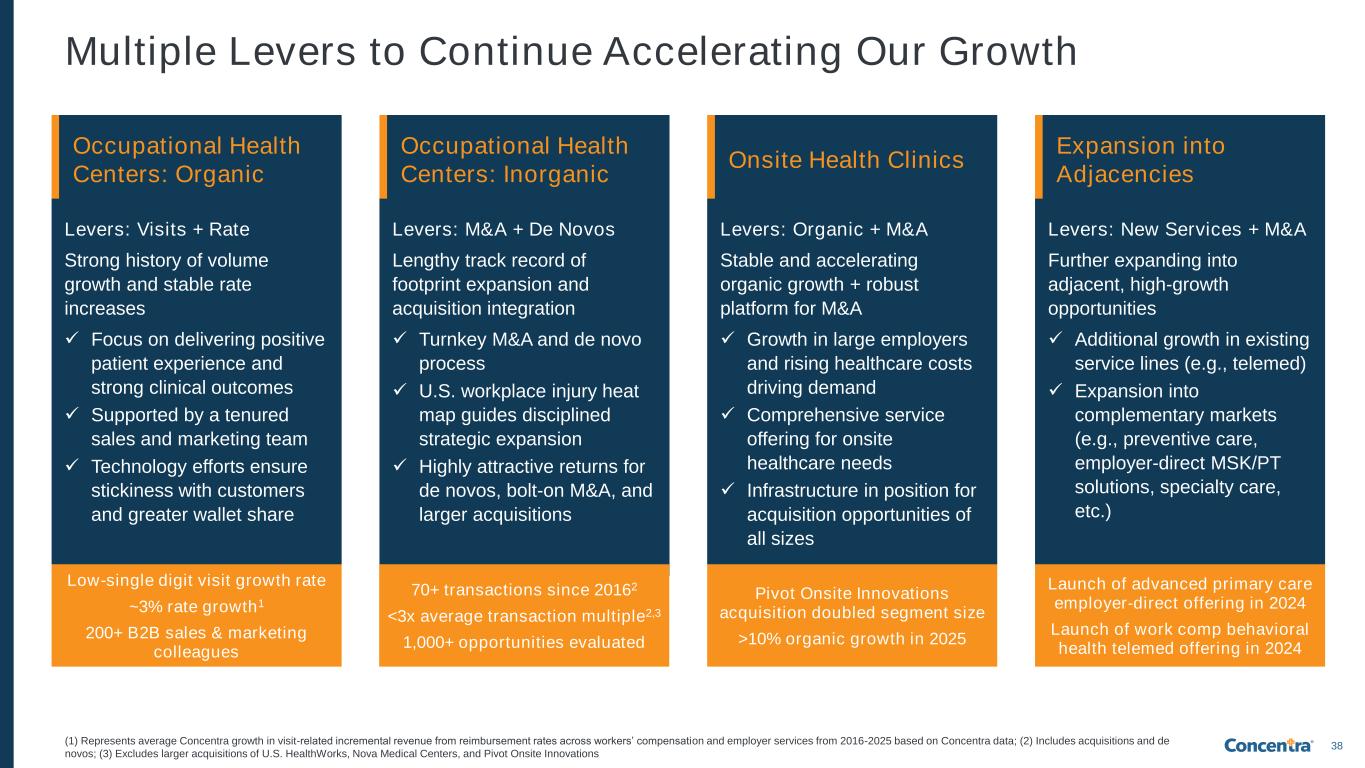
38 Multiple Levers to Continue Accelerating Our Growth (1) Represents average Concentra growth in visit-related incremental revenue from reimbursement rates across workers’ compensation and employer services from 2016-2025 based on Concentra data; (2) Includes acquisitions and de novos; (3) Excludes larger acquisitions of U.S. HealthWorks, Nova Medical Centers, and Pivot Onsite Innovations Levers: M&A + De Novos Lengthy track record of footprint expansion and acquisition integration ✓ Turnkey M&A and de novo process ✓ U.S. workplace injury heat map guides disciplined strategic expansion ✓ Highly attractive returns for de novos, bolt-on M&A, and larger acquisitions Occupational Health Centers: Inorganic Levers: Visits + Rate Strong history of volume growth and stable rate increases ✓ Focus on delivering positive patient experience and strong clinical outcomes ✓ Supported by a tenured sales and marketing team ✓ Technology efforts ensure stickiness with customers and greater wallet share Occupational Health Centers: Organic Levers: Organic + M&A Stable and accelerating organic growth + robust platform for M&A ✓ Growth in large employers and rising healthcare costs driving demand ✓ Comprehensive service offering for onsite healthcare needs ✓ Infrastructure in position for acquisition opportunities of all sizes Onsite Health Clinics Levers: New Services + M&A Further expanding into adjacent, high-growth opportunities ✓ Additional growth in existing service lines (e.g., telemed) ✓ Expansion into complementary markets (e.g., preventive care, employer-direct MSK/PT solutions, specialty care, etc.) Expansion into Adjacencies 70+ transactions since 20162 <3x average transaction multiple2,3 1,000+ opportunities evaluated Low-single digit visit growth rate ~3% rate growth1 200+ B2B sales & marketing colleagues Pivot Onsite Innovations acquisition doubled segment size >10% organic growth in 2025 Launch of advanced primary care employer-direct offering in 2024 Launch of work comp behavioral health telemed offering in 2024
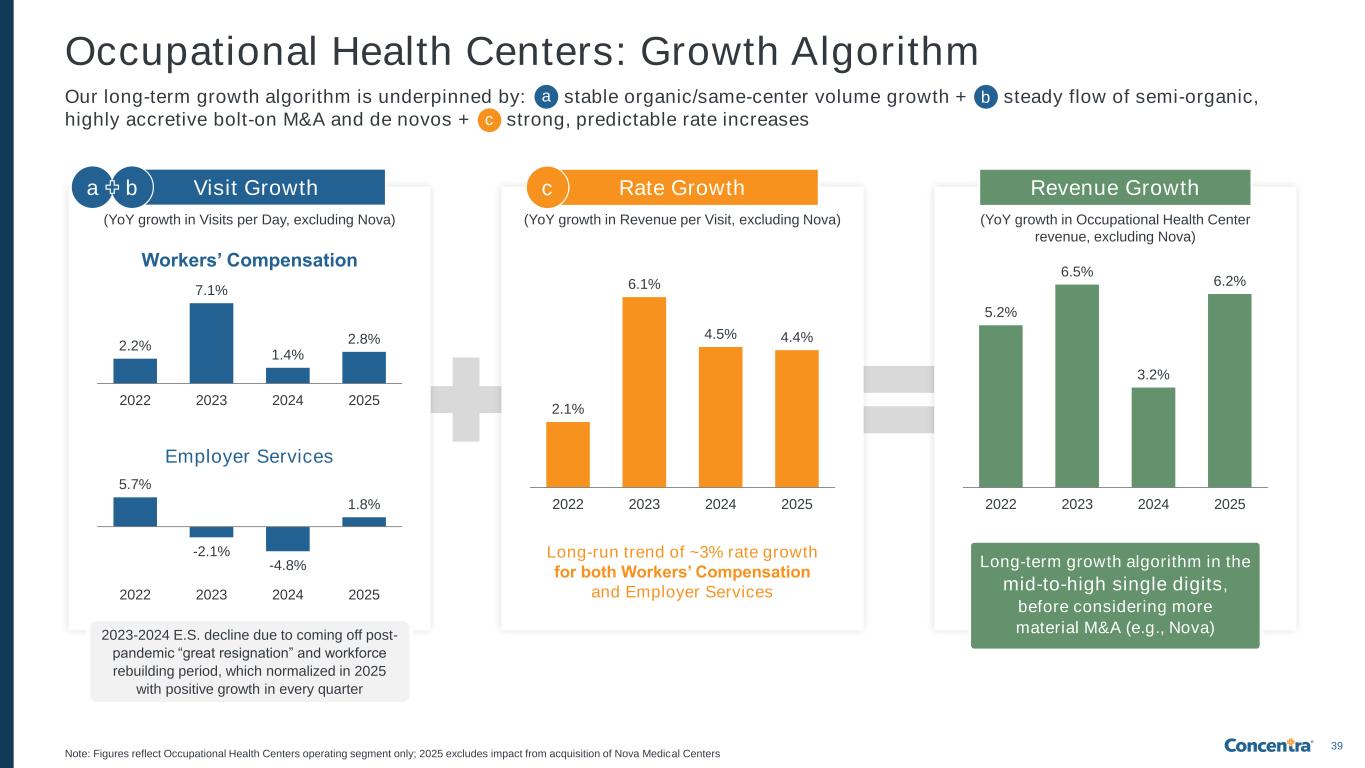
39 Occupational Health Centers: Growth Algorithm Note: Figures reflect Occupational Health Centers operating segment only; 2025 excludes impact from acquisition of Nova Medical Centers Our long-term growth algorithm is underpinned by: stable organic/same-center volume growth + steady flow of semi-organic, highly accretive bolt-on M&A and de novos + strong, predictable rate increases (YoY growth in Visits per Day, excluding Nova) 2023-2024 E.S. decline due to coming off post- pandemic “great resignation” and workforce rebuilding period, which normalized in 2025 with positive growth in every quarter Workers’ Compensation Employer Services Visit Growth 2.2% 7.1% 1.4% 2.8% 2022 2023 2024 2025 5.7% -2.1% -4.8% 1.8% 2022 2023 2024 2025 2.1% 6.1% 4.5% 4.4% 2022 2023 2024 2025 Rate Growth (YoY growth in Revenue per Visit, excluding Nova) Long-run trend of ~3% rate growth for both Workers’ Compensation and Employer Services 5.2% 6.5% 3.2% 6.2% 2022 2023 2024 2025 Revenue Growth (YoY growth in Occupational Health Center revenue, excluding Nova) Long-term growth algorithm in the mid-to-high single digits, before considering more material M&A (e.g., Nova) a b c a b c
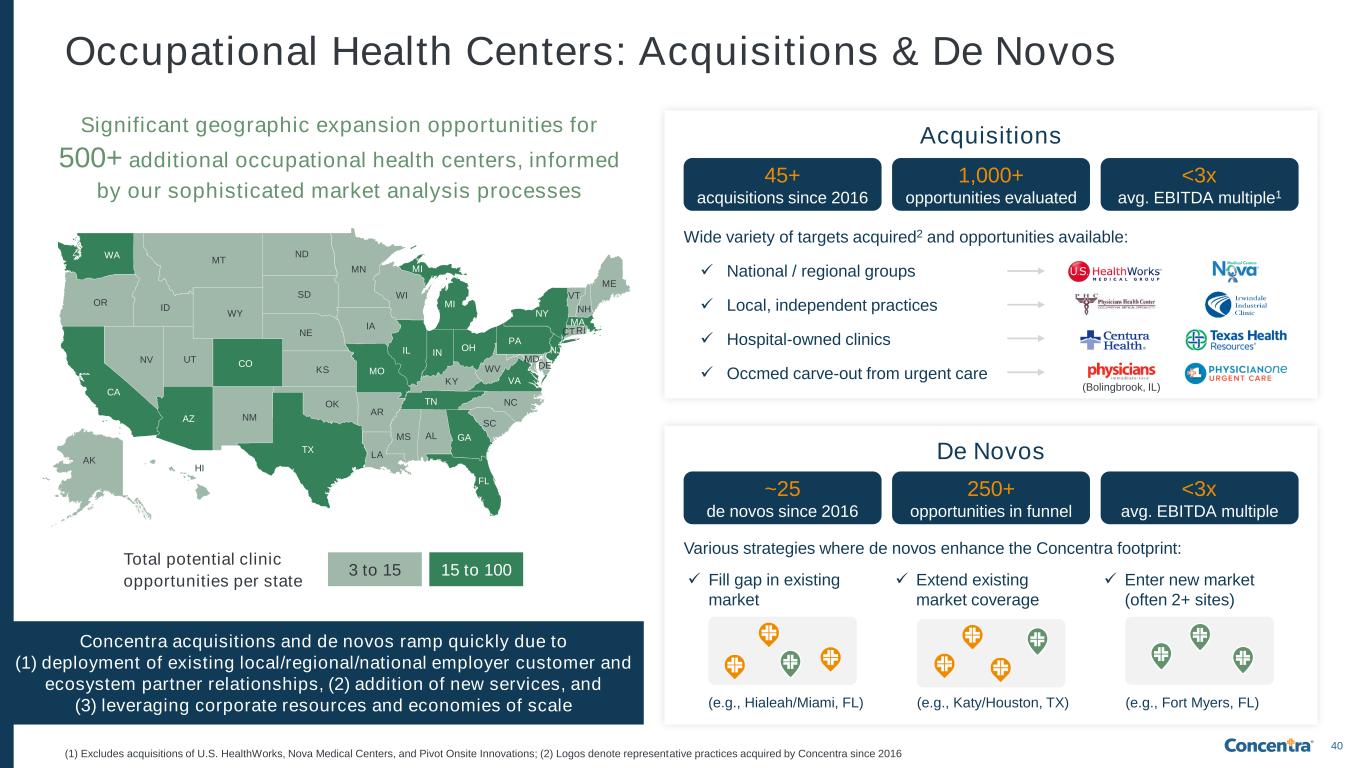
40 Occupational Health Centers: Acquisitions & De Novos TX MT CA ID NV AZ OR IL NM CO WY MN SD IA ND UT KS NE WA WI OK MI MO NY PA FL IN AL GA AR LA NC VA TN KY OH MS ME SC MI WV VT NH MA CT NJ MD DE RI AK HI 3 to 15 15 to 100 Total potential clinic opportunities per state Significant geographic expansion opportunities for 500+ additional occupational health centers, informed by our sophisticated market analysis processes Acquisitions De Novos 45+ acquisitions since 2016 1,000+ opportunities evaluated <3x avg. EBITDA multiple1 (1) Excludes acquisitions of U.S. HealthWorks, Nova Medical Centers, and Pivot Onsite Innovations; (2) Logos denote representative practices acquired by Concentra since 2016 ~25 de novos since 2016 250+ opportunities in funnel <3x avg. EBITDA multiple Wide variety of targets acquired2 and opportunities available: ✓ National / regional groups ✓ Local, independent practices ✓ Hospital-owned clinics ✓ Occmed carve-out from urgent care Various strategies where de novos enhance the Concentra footprint: ✓ Fill gap in existing market ✓ Extend existing market coverage ✓ Enter new market (often 2+ sites) (e.g., Katy/Houston, TX)(e.g., Hialeah/Miami, FL) (e.g., Fort Myers, FL) Concentra acquisitions and de novos ramp quickly due to (1) deployment of existing local/regional/national employer customer and ecosystem partner relationships, (2) addition of new services, and (3) leveraging corporate resources and economies of scale (Bolingbrook, IL)
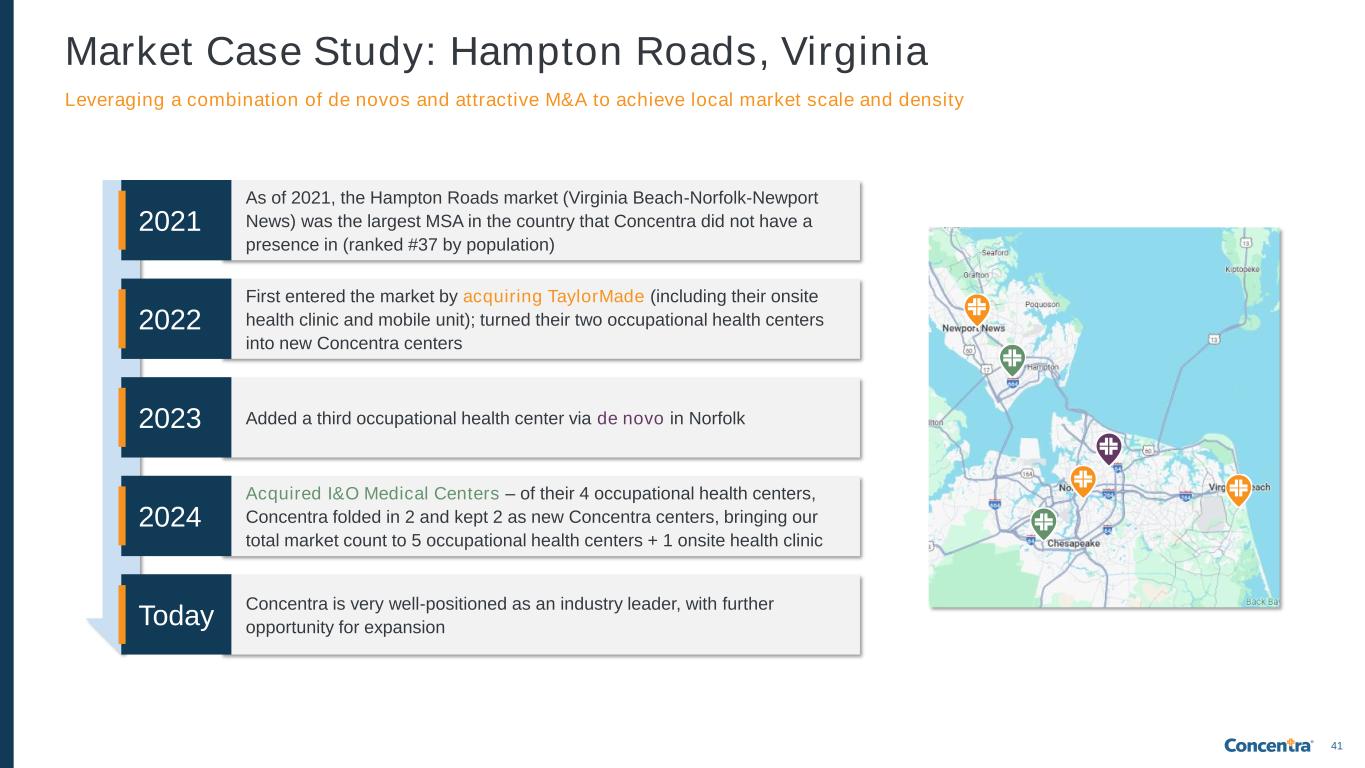
41 Market Case Study: Hampton Roads, Virginia Leveraging a combination of de novos and attractive M&A to achieve local market scale and density First entered the market by acquiring TaylorMade (including their onsite health clinic and mobile unit); turned their two occupational health centers into new Concentra centers Added a third occupational health center via de novo in Norfolk Acquired I&O Medical Centers – of their 4 occupational health centers, Concentra folded in 2 and kept 2 as new Concentra centers, bringing our total market count to 5 occupational health centers + 1 onsite health clinic As of 2021, the Hampton Roads market (Virginia Beach-Norfolk-Newport News) was the largest MSA in the country that Concentra did not have a presence in (ranked #37 by population) Concentra is very well-positioned as an industry leader, with further opportunity for expansion 2021 2022 2023 2024 Today
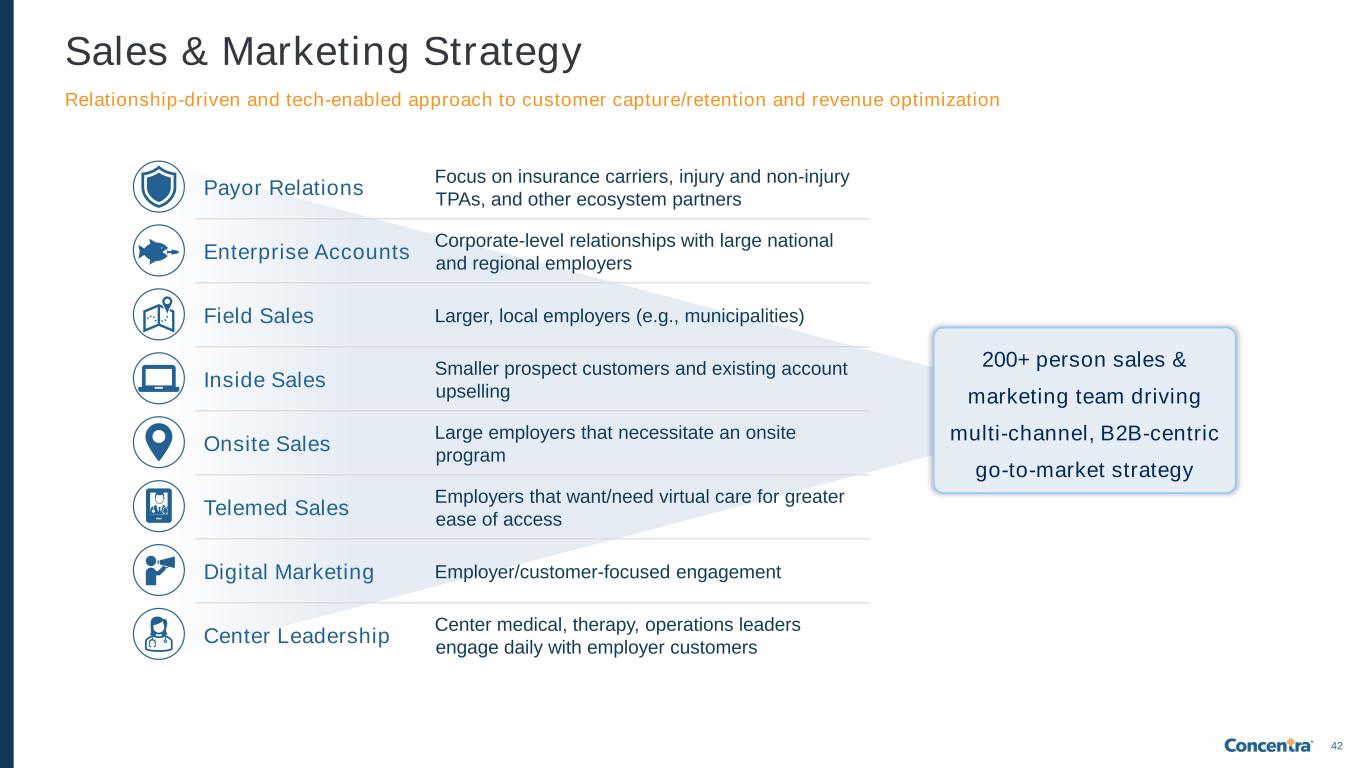
42 Sales & Marketing Strategy Relationship-driven and tech-enabled approach to customer capture/retention and revenue optimization Payor Relations Focus on insurance carriers, injury and non-injury TPAs, and other ecosystem partners Enterprise Accounts Corporate-level relationships with large national and regional employers Field Sales Larger, local employers (e.g., municipalities) Inside Sales Smaller prospect customers and existing account upselling Onsite Sales Large employers that necessitate an onsite program Telemed Sales Employers that want/need virtual care for greater ease of access Digital Marketing Employer/customer-focused engagement Center Leadership Center medical, therapy, operations leaders engage daily with employer customers 200+ person sales & marketing team driving multi-channel, B2B-centric go-to-market strategy

Spotlight: Onsite Health Clinics
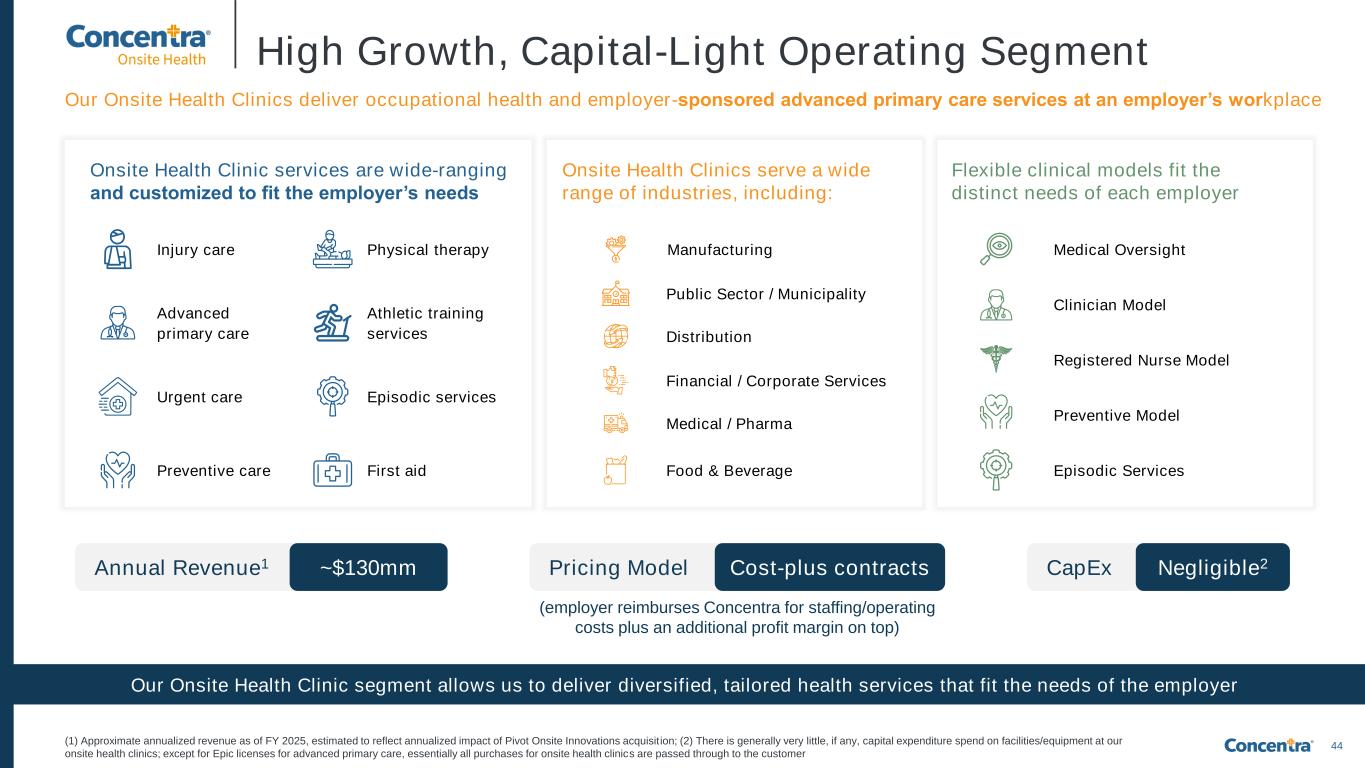
44 High Growth, Capital-Light Operating Segment Preventive care Injury care Physical therapy Advanced primary care Athletic training services Urgent care Episodic services First aid Medical Oversight Clinician Model Registered Nurse Model Preventive Model Episodic Services Onsite Health Clinic services are wide-ranging and customized to fit the employer’s needs Onsite Health Clinics serve a wide range of industries, including: Flexible clinical models fit the distinct needs of each employer Manufacturing (1) Approximate annualized revenue as of FY 2025, estimated to reflect annualized impact of Pivot Onsite Innovations acquisit ion; (2) There is generally very little, if any, capital expenditure spend on facilities/equipment at our onsite health clinics; except for Epic licenses for advanced primary care, essentially all purchases for onsite health clinics are passed through to the customer Our Onsite Health Clinics deliver occupational health and employer-sponsored advanced primary care services at an employer’s workplace Our Onsite Health Clinic segment allows us to deliver diversified, tailored health services that fit the needs of the employer Public Sector / Municipality Distribution Financial / Corporate Services Medical / Pharma Food & Beverage Annual Revenue1 ~$130mm Pricing Model Cost-plus contracts CapEx Negligible2 (employer reimburses Concentra for staffing/operating costs plus an additional profit margin on top)
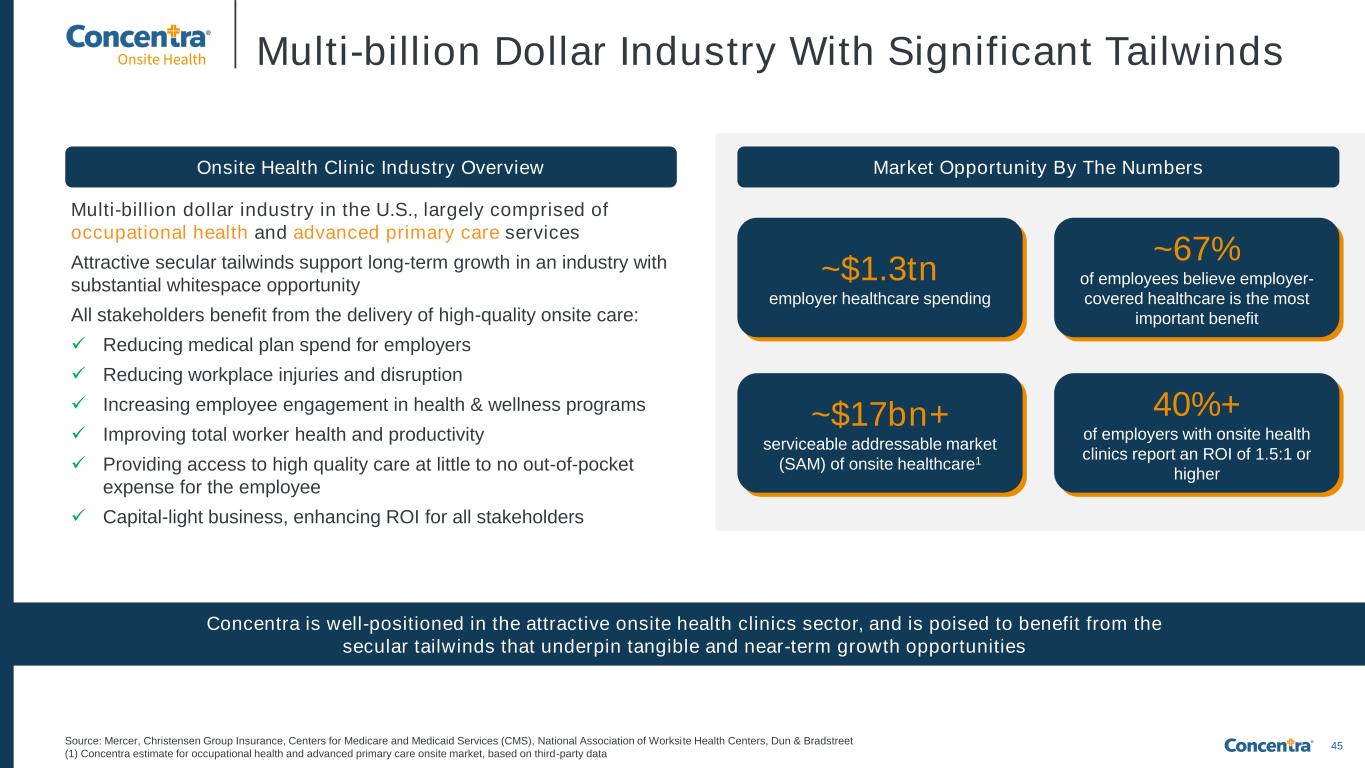
45 Multi-billion Dollar Industry With Significant Tailwinds Source: Mercer, Christensen Group Insurance, Centers for Medicare and Medicaid Services (CMS), National Association of Worksite Health Centers, Dun & Bradstreet (1) Concentra estimate for occupational health and advanced primary care onsite market, based on third-party data Onsite Health Clinic Industry Overview Multi-billion dollar industry in the U.S., largely comprised of occupational health and advanced primary care services Attractive secular tailwinds support long-term growth in an industry with substantial whitespace opportunity All stakeholders benefit from the delivery of high-quality onsite care: ✓ Reducing medical plan spend for employers ✓ Reducing workplace injuries and disruption ✓ Increasing employee engagement in health & wellness programs ✓ Improving total worker health and productivity ✓ Providing access to high quality care at little to no out-of-pocket expense for the employee ✓ Capital-light business, enhancing ROI for all stakeholders Market Opportunity By The Numbers ~$1.3tn employer healthcare spending 40%+ of employers with onsite health clinics report an ROI of 1.5:1 or higher ~$17bn+ serviceable addressable market (SAM) of onsite healthcare1 ~67% of employees believe employer- covered healthcare is the most important benefit Concentra is well-positioned in the attractive onsite health clinics sector, and is poised to benefit from the secular tailwinds that underpin tangible and near-term growth opportunities
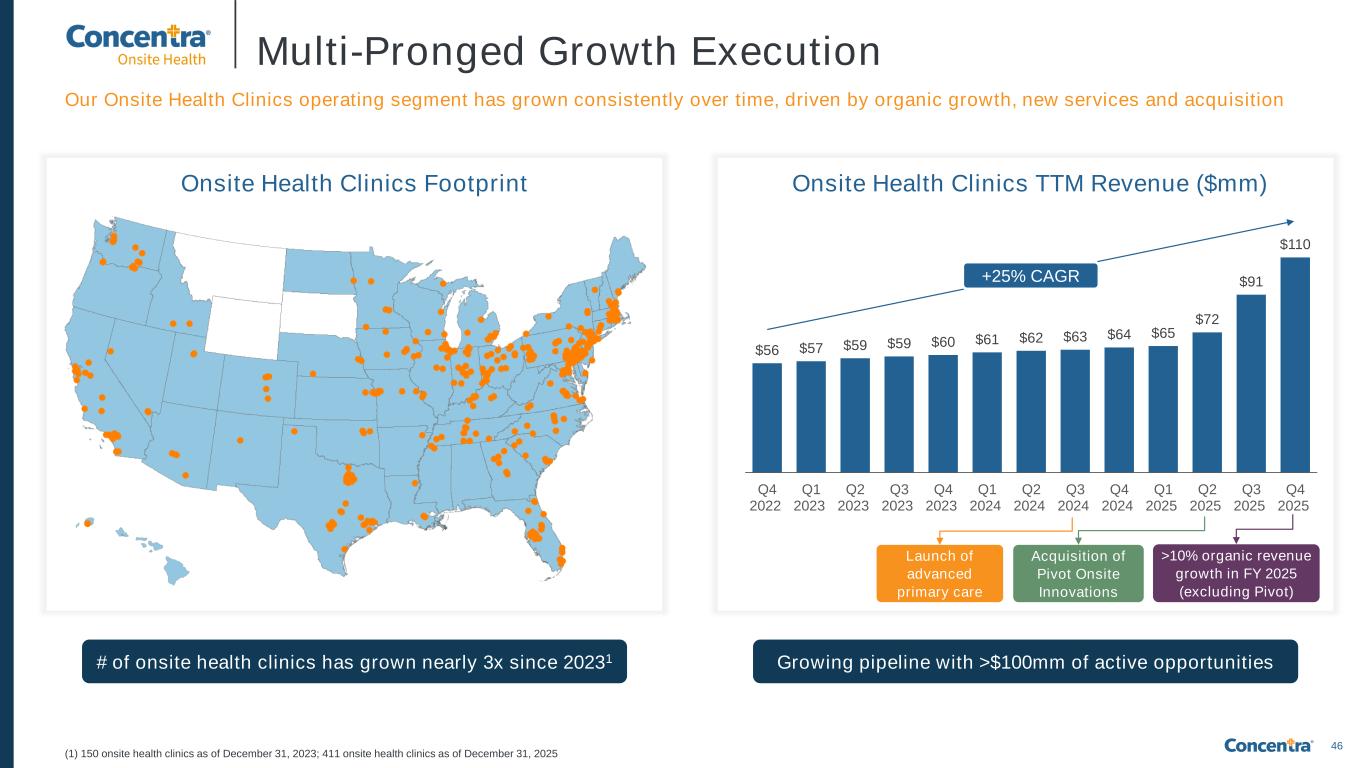
46 Multi-Pronged Growth Execution $56 $57 $59 $59 $60 $61 $62 $63 $64 $65 $72 $91 $110 Q4 2022 Q1 2023 Q2 2023 Q3 2023 Q4 2023 Q1 2024 Q2 2024 Q3 2024 Q4 2024 Q1 2025 Q2 2025 Q3 2025 Q4 2025 Onsite Health Clinics TTM Revenue ($mm) +25% CAGR Our Onsite Health Clinics operating segment has grown consistently over time, driven by organic growth, new services and acquisition Launch of advanced primary care Acquisition of Pivot Onsite Innovations # of onsite health clinics has grown nearly 3x since 20231 (1) 150 onsite health clinics as of December 31, 2023; 411 onsite health clinics as of December 31, 2025 >10% organic revenue growth in FY 2025 (excluding Pivot) Onsite Health Clinics Footprint Growing pipeline with >$100mm of active opportunities
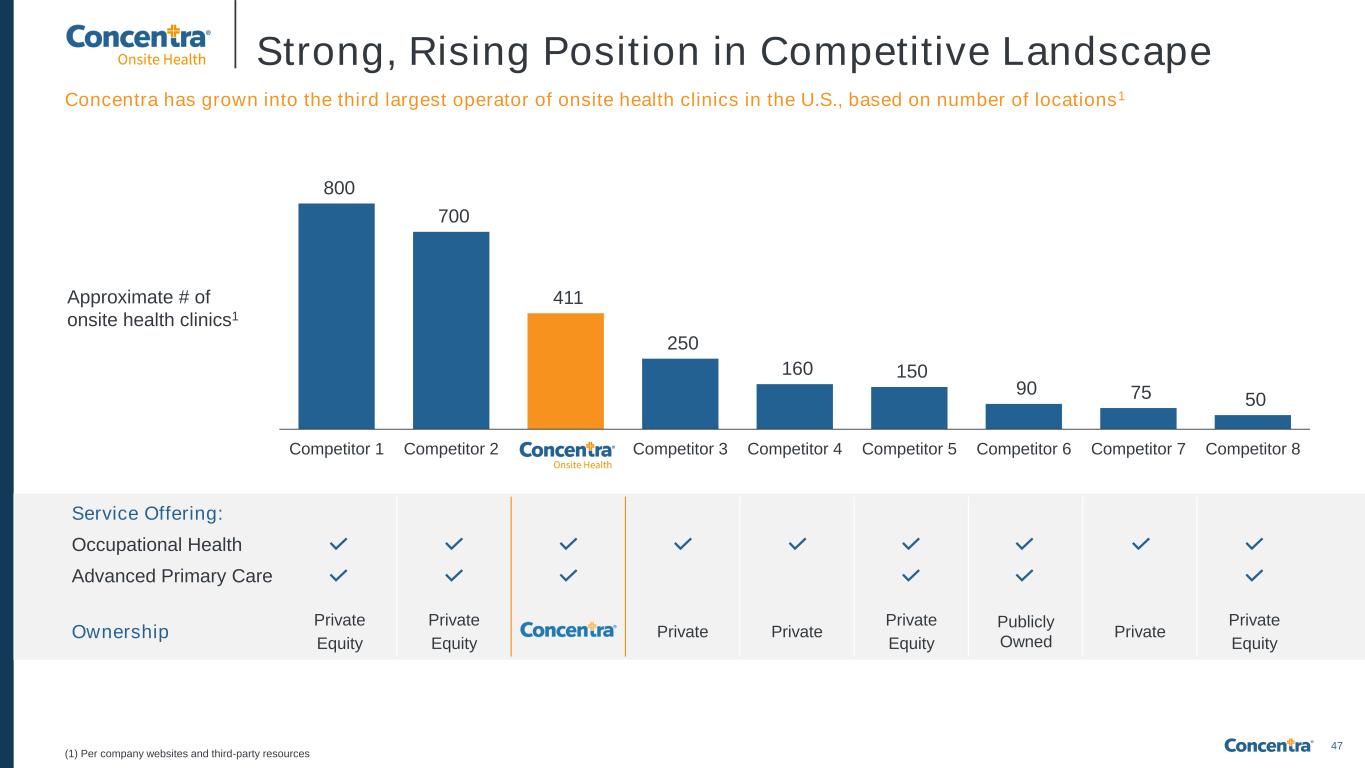
47 Strong, Rising Position in Competitive Landscape (1) Per company websites and third-party resources 800 700 411 250 160 150 90 75 50 Competitor 1 Competitor 2 Competitor 3 Competitor 4 Competitor 5 Competitor 6 Competitor 7 Competitor 8 Approximate # of onsite health clinics1 Service Offering: Occupational Health Advanced Primary Care Ownership Private Equity Private Equity Private Private Private Equity Publicly Owned Private Private Equity Concentra has grown into the third largest operator of onsite health clinics in the U.S., based on number of locations1

Financial Performance
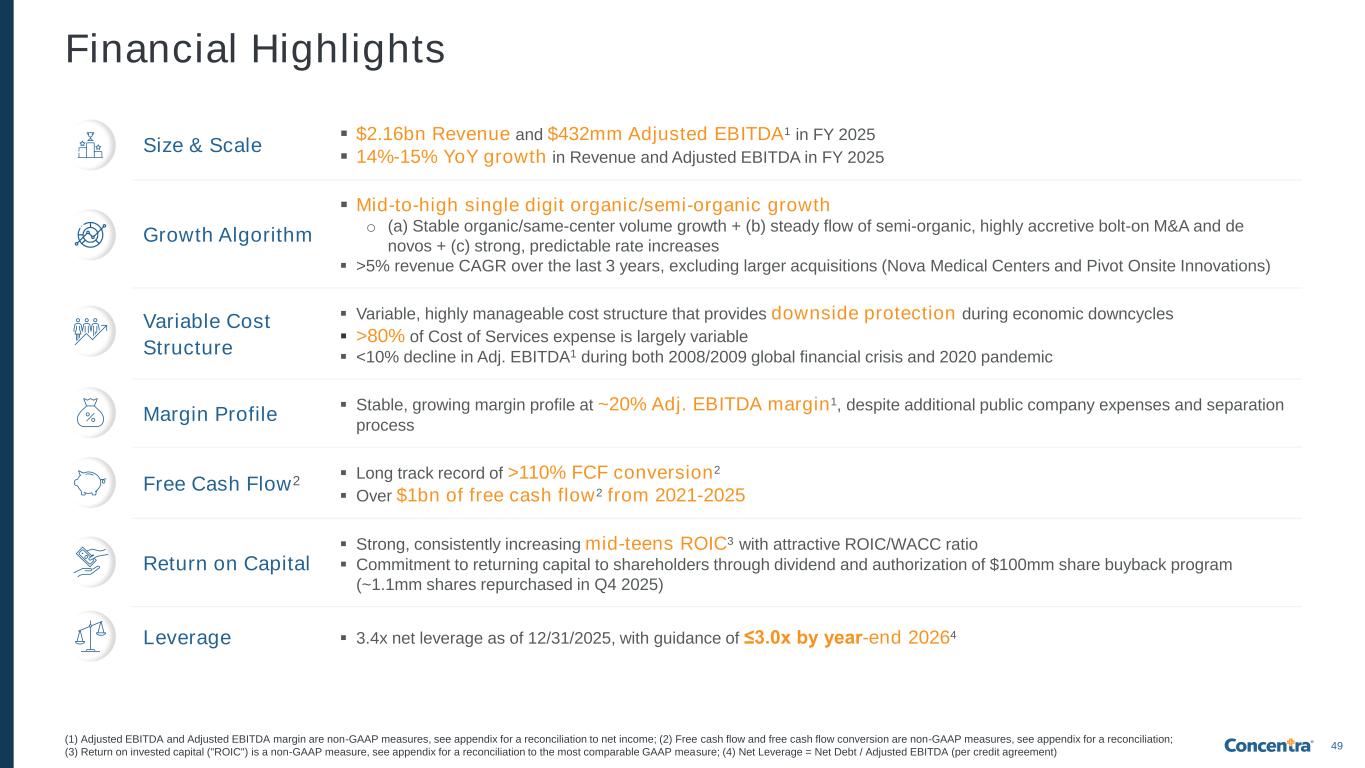
49 Financial Highlights Size & Scale ▪ $2.16bn Revenue and $432mm Adjusted EBITDA1 in FY 2025 ▪ 14%-15% YoY growth in Revenue and Adjusted EBITDA in FY 2025 Growth Algorithm ▪ Mid-to-high single digit organic/semi-organic growth o (a) Stable organic/same-center volume growth + (b) steady flow of semi-organic, highly accretive bolt-on M&A and de novos + (c) strong, predictable rate increases ▪ >5% revenue CAGR over the last 3 years, excluding larger acquisitions (Nova Medical Centers and Pivot Onsite Innovations) Variable Cost Structure ▪ Variable, highly manageable cost structure that provides downside protection during economic downcycles ▪ >80% of Cost of Services expense is largely variable ▪ <10% decline in Adj. EBITDA1 during both 2008/2009 global financial crisis and 2020 pandemic Margin Profile ▪ Stable, growing margin profile at ~20% Adj. EBITDA margin1, despite additional public company expenses and separation process Free Cash Flow2 ▪ Long track record of >110% FCF conversion2 ▪ Over $1bn of free cash flow2 from 2021-2025 Return on Capital ▪ Strong, consistently increasing mid-teens ROIC3 with attractive ROIC/WACC ratio ▪ Commitment to returning capital to shareholders through dividend and authorization of $100mm share buyback program (~1.1mm shares repurchased in Q4 2025) Leverage ▪ 3.4x net leverage as of 12/31/2025, with guidance of ≤3.0x by year-end 20264 (1) Adjusted EBITDA and Adjusted EBITDA margin are non-GAAP measures, see appendix for a reconciliation to net income; (2) Free cash flow and free cash flow conversion are non-GAAP measures, see appendix for a reconciliation; (3) Return on invested capital ("ROIC") is a non-GAAP measure, see appendix for a reconciliation to the most comparable GAAP measure; (4) Net Leverage = Net Debt / Adjusted EBITDA (per credit agreement)
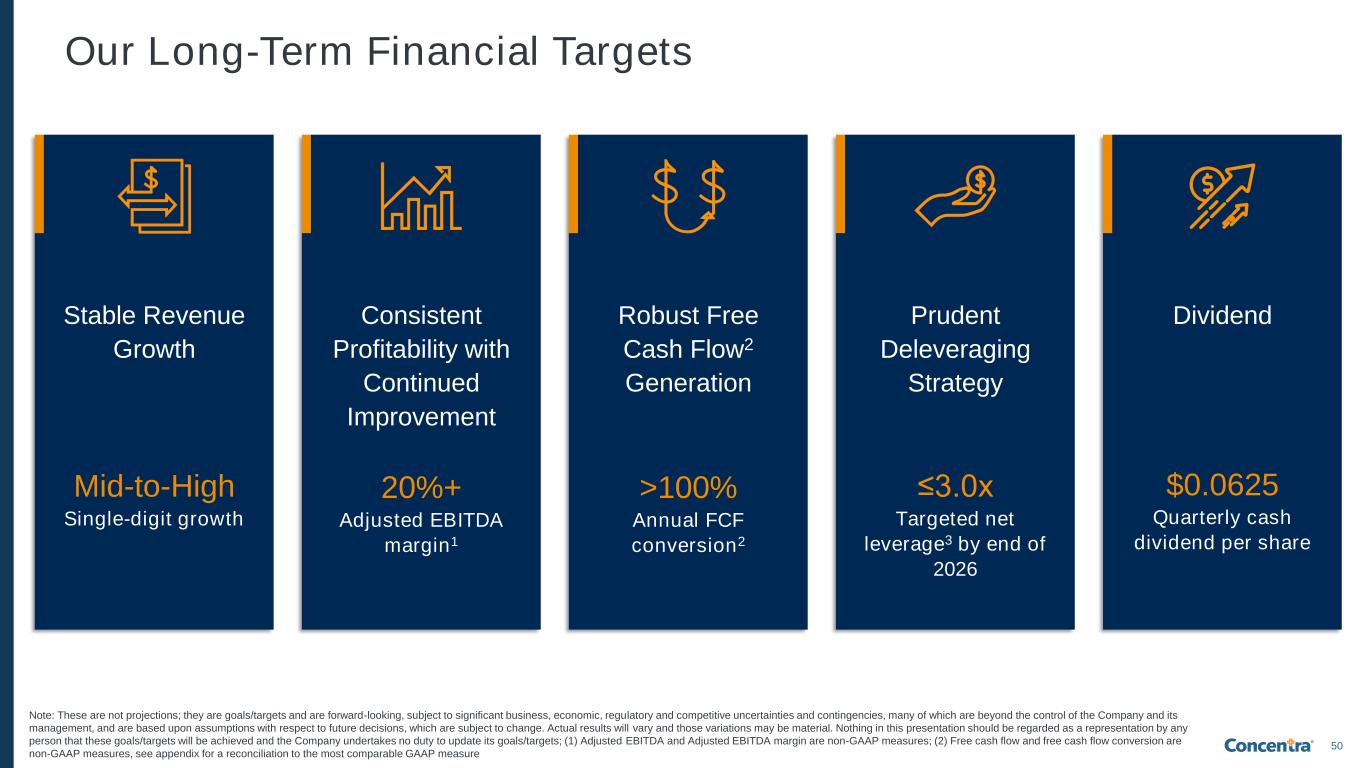
50 Consistent Profitability with Continued Improvement 20%+ Adjusted EBITDA margin1 Robust Free Cash Flow2 Generation >100% Annual FCF conversion2 Prudent Deleveraging Strategy ≤3.0x Targeted net leverage3 by end of 2026 Stable Revenue Growth Mid-to-High Single-digit growth Dividend $0.0625 Quarterly cash dividend per share Note: These are not projections; they are goals/targets and are forward-looking, subject to significant business, economic, regulatory and competitive uncertainties and contingencies, many of which are beyond the control of the Company and its management, and are based upon assumptions with respect to future decisions, which are subject to change. Actual results will vary and those variations may be material. Nothing in this presentation should be regarded as a representation by any person that these goals/targets will be achieved and the Company undertakes no duty to update its goals/targets; (1) Adjusted EBITDA and Adjusted EBITDA margin are non-GAAP measures; (2) Free cash flow and free cash flow conversion are non-GAAP measures, see appendix for a reconciliation to the most comparable GAAP measure Our Long-Term Financial Targets
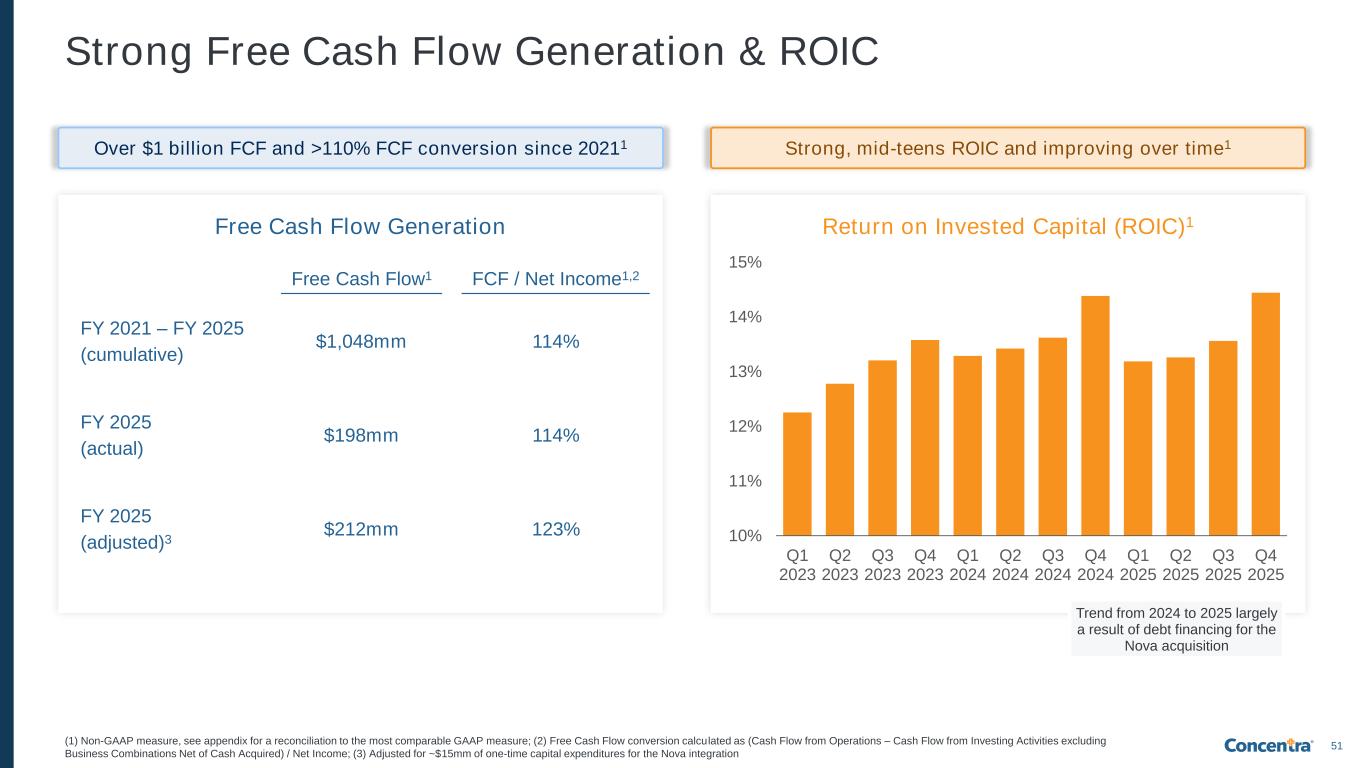
51 Free Cash Flow Generation Strong Free Cash Flow Generation & ROIC (1) Non-GAAP measure, see appendix for a reconciliation to the most comparable GAAP measure; (2) Free Cash Flow conversion calculated as (Cash Flow from Operations – Cash Flow from Investing Activities excluding Business Combinations Net of Cash Acquired) / Net Income; (3) Adjusted for ~$15mm of one-time capital expenditures for the Nova integration Free Cash Flow1 FCF / Net Income1,2 FY 2021 – FY 2025 (cumulative) $1,048mm 114% FY 2025 (actual) $198mm 114% FY 2025 (adjusted)3 $212mm 123% 10% 11% 12% 13% 14% 15% Q1 2023 Q2 2023 Q3 2023 Q4 2023 Q1 2024 Q2 2024 Q3 2024 Q4 2024 Q1 2025 Q2 2025 Q3 2025 Q4 2025 Return on Invested Capital (ROIC)1 Over $1 billion FCF and >110% FCF conversion since 20211 Strong, mid-teens ROIC and improving over time1 Trend from 2024 to 2025 largely a result of debt financing for the Nova acquisition
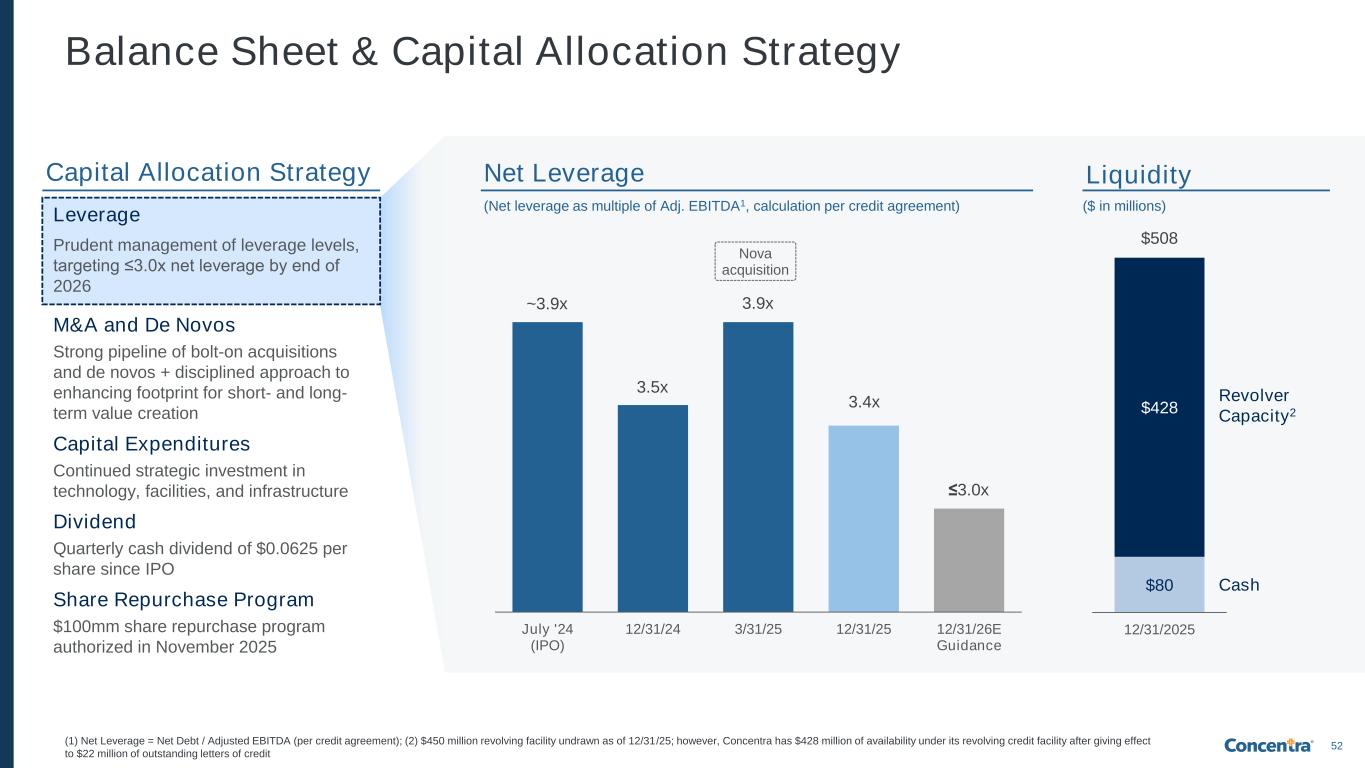
52 Leverage Prudent management of leverage levels, targeting ≤3.0x net leverage by end of 2026 M&A and De Novos Strong pipeline of bolt-on acquisitions and de novos + disciplined approach to enhancing footprint for short- and long- term value creation Capital Expenditures Continued strategic investment in technology, facilities, and infrastructure Dividend Quarterly cash dividend of $0.0625 per share since IPO Share Repurchase Program $100mm share repurchase program authorized in November 2025 Net Leverage Liquidity $80 $428 $508 12/31/2025 Cash Revolver Capacity2 ($ in millions) Capital Allocation Strategy (Net leverage as multiple of Adj. EBITDA1, calculation per credit agreement) ~3.9x 3.5x 3.9x 3.4x ≤3.0x July '24 (IPO) 12/31/24 3/31/25 12/31/25 12/31/26E Guidance Nova acquisition (1) Net Leverage = Net Debt / Adjusted EBITDA (per credit agreement); (2) $450 million revolving facility undrawn as of 12/31/25; however, Concentra has $428 million of availability under its revolving credit facility after giving effect to $22 million of outstanding letters of credit Balance Sheet & Capital Allocation Strategy
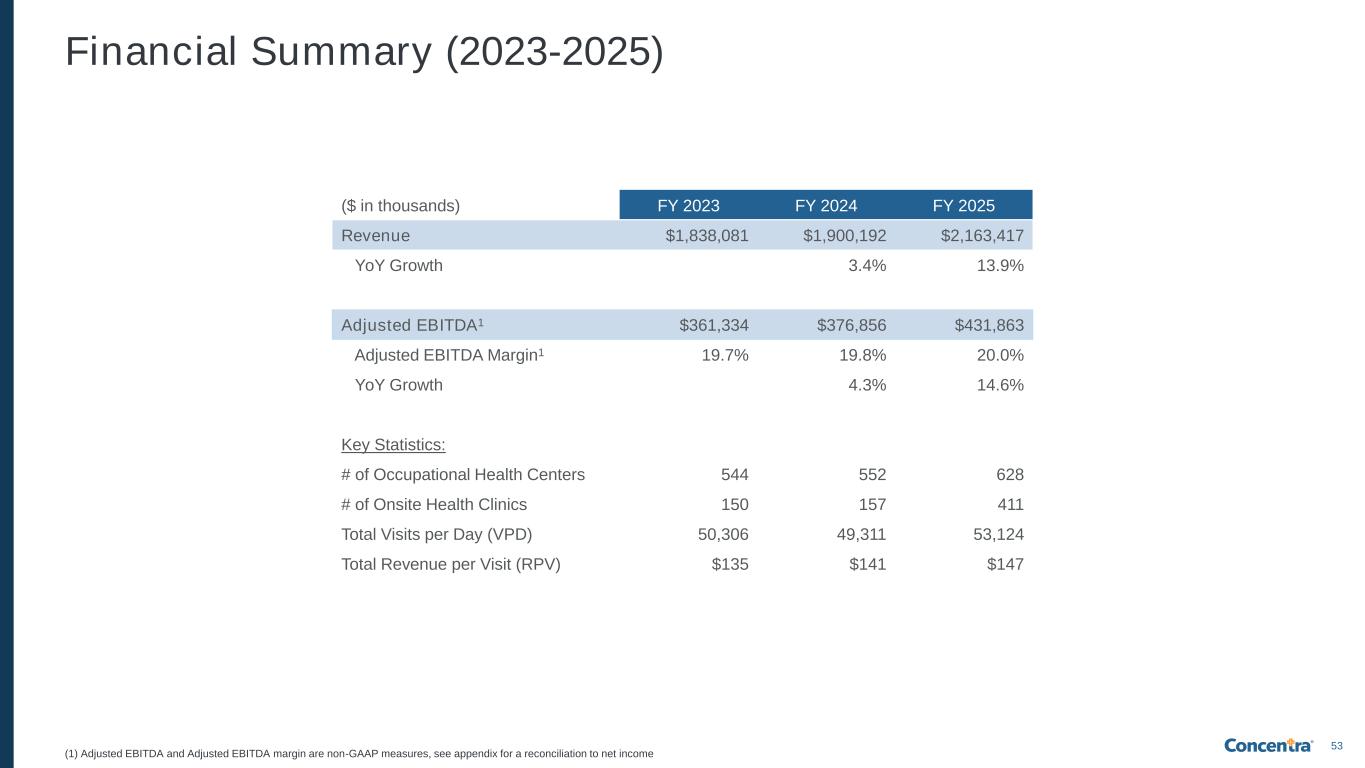
53 Financial Summary (2023-2025) ($ in thousands) FY 2023 FY 2024 FY 2025 Revenue $1,838,081 $1,900,192 $2,163,417 YoY Growth 3.4% 13.9% Adjusted EBITDA1 $361,334 $376,856 $431,863 Adjusted EBITDA Margin1 19.7% 19.8% 20.0% YoY Growth 4.3% 14.6% Key Statistics: # of Occupational Health Centers 544 552 628 # of Onsite Health Clinics 150 157 411 Total Visits per Day (VPD) 50,306 49,311 53,124 Total Revenue per Visit (RPV) $135 $141 $147 (1) Adjusted EBITDA and Adjusted EBITDA margin are non-GAAP measures, see appendix for a reconciliation to net income

Appendix
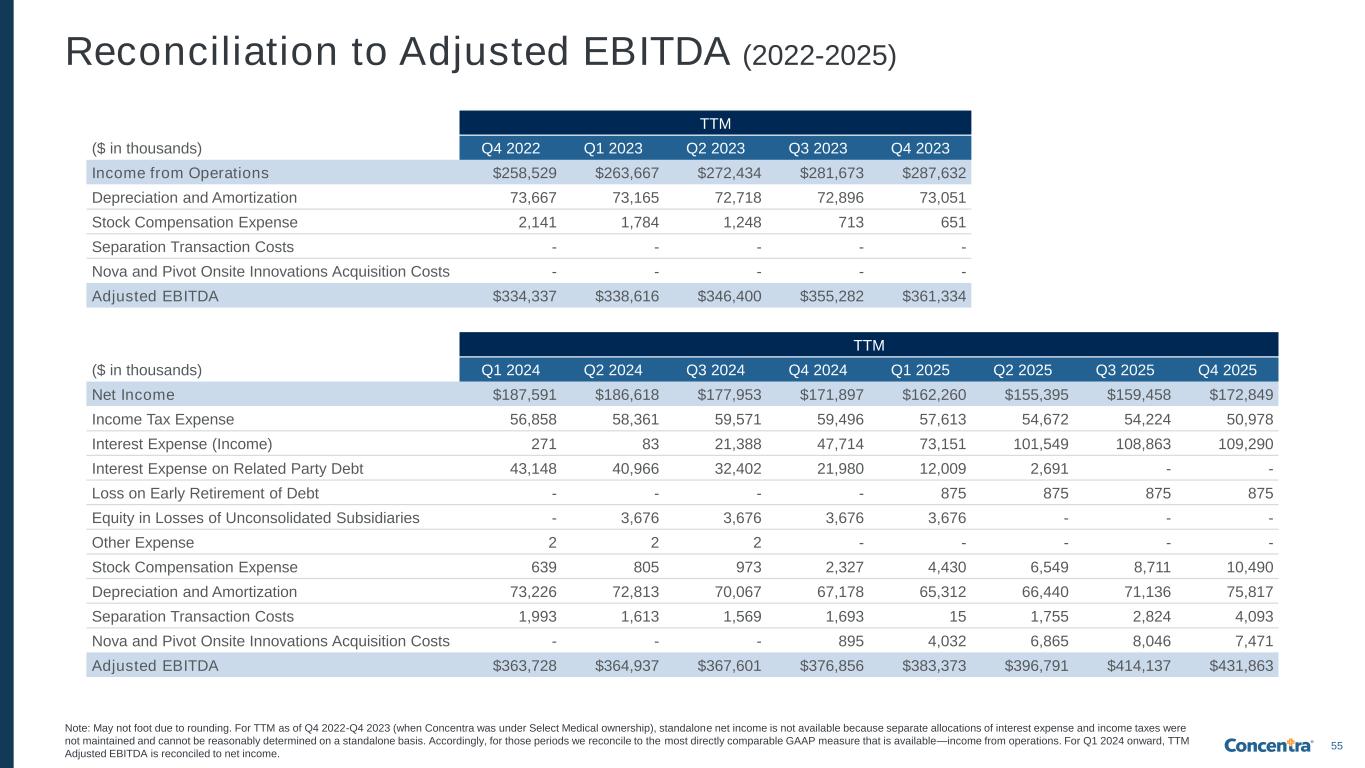
55 Reconciliation to Adjusted EBITDA (2022-2025) TTM ($ in thousands) Q4 2022 Q1 2023 Q2 2023 Q3 2023 Q4 2023 Income from Operations $258,529 $263,667 $272,434 $281,673 $287,632 Depreciation and Amortization 73,667 73,165 72,718 72,896 73,051 Stock Compensation Expense 2,141 1,784 1,248 713 651 Separation Transaction Costs - - - - - Nova and Pivot Onsite Innovations Acquisition Costs - - - - - Adjusted EBITDA $334,337 $338,616 $346,400 $355,282 $361,334 TTM ($ in thousands) Q1 2024 Q2 2024 Q3 2024 Q4 2024 Q1 2025 Q2 2025 Q3 2025 Q4 2025 Net Income $187,591 $186,618 $177,953 $171,897 $162,260 $155,395 $159,458 $172,849 Income Tax Expense 56,858 58,361 59,571 59,496 57,613 54,672 54,224 50,978 Interest Expense (Income) 271 83 21,388 47,714 73,151 101,549 108,863 109,290 Interest Expense on Related Party Debt 43,148 40,966 32,402 21,980 12,009 2,691 - - Loss on Early Retirement of Debt - - - - 875 875 875 875 Equity in Losses of Unconsolidated Subsidiaries - 3,676 3,676 3,676 3,676 - - - Other Expense 2 2 2 - - - - - Stock Compensation Expense 639 805 973 2,327 4,430 6,549 8,711 10,490 Depreciation and Amortization 73,226 72,813 70,067 67,178 65,312 66,440 71,136 75,817 Separation Transaction Costs 1,993 1,613 1,569 1,693 15 1,755 2,824 4,093 Nova and Pivot Onsite Innovations Acquisition Costs - - - 895 4,032 6,865 8,046 7,471 Adjusted EBITDA $363,728 $364,937 $367,601 $376,856 $383,373 $396,791 $414,137 $431,863 Note: May not foot due to rounding. For TTM as of Q4 2022-Q4 2023 (when Concentra was under Select Medical ownership), standalone net income is not available because separate allocations of interest expense and income taxes were not maintained and cannot be reasonably determined on a standalone basis. Accordingly, for those periods we reconcile to the most directly comparable GAAP measure that is available—income from operations. For Q1 2024 onward, TTM Adjusted EBITDA is reconciled to net income.
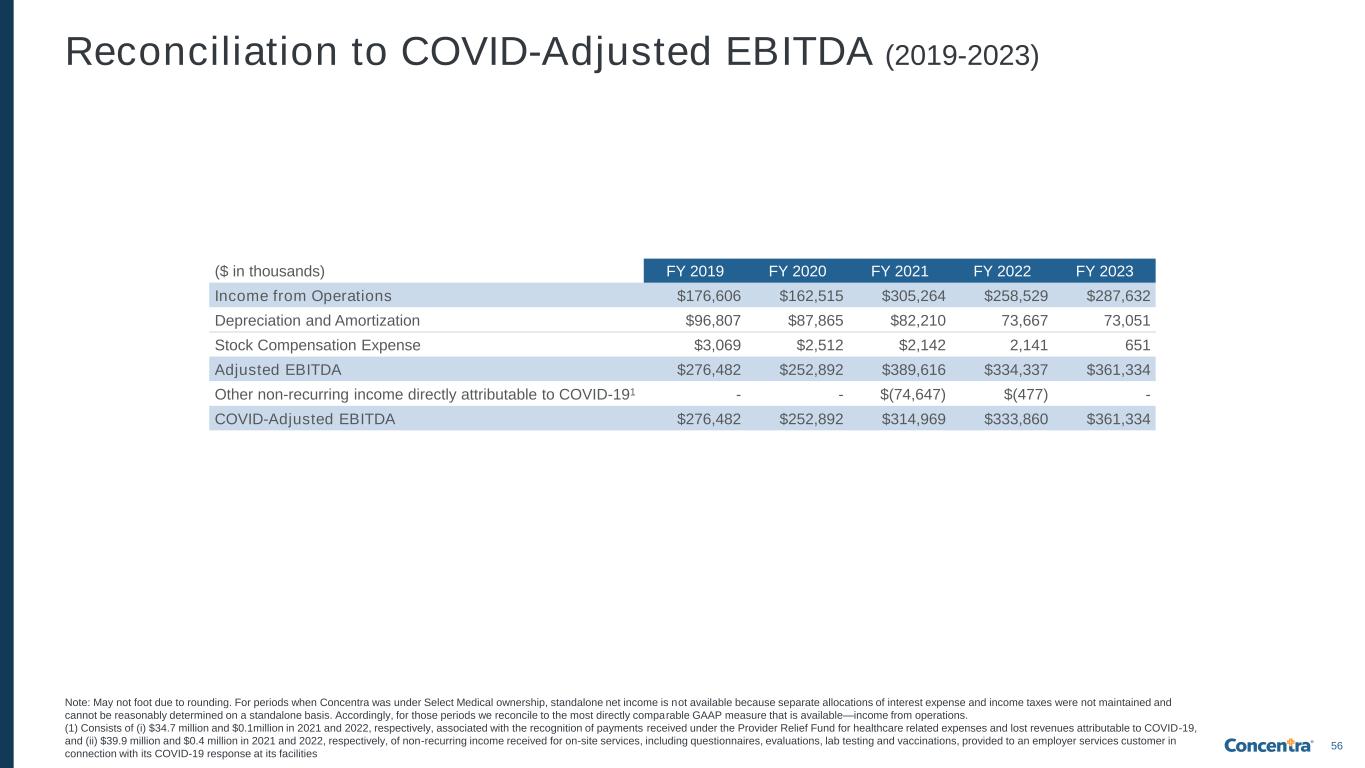
56 Reconciliation to COVID-Adjusted EBITDA (2019-2023) ($ in thousands) FY 2019 FY 2020 FY 2021 FY 2022 FY 2023 Income from Operations $176,606 $162,515 $305,264 $258,529 $287,632 Depreciation and Amortization $96,807 $87,865 $82,210 73,667 73,051 Stock Compensation Expense $3,069 $2,512 $2,142 2,141 651 Adjusted EBITDA $276,482 $252,892 $389,616 $334,337 $361,334 Other non-recurring income directly attributable to COVID-191 - - $(74,647) $(477) - COVID-Adjusted EBITDA $276,482 $252,892 $314,969 $333,860 $361,334 Note: May not foot due to rounding. For periods when Concentra was under Select Medical ownership, standalone net income is not available because separate allocations of interest expense and income taxes were not maintained and cannot be reasonably determined on a standalone basis. Accordingly, for those periods we reconcile to the most directly comparable GAAP measure that is available—income from operations. (1) Consists of (i) $34.7 million and $0.1million in 2021 and 2022, respectively, associated with the recognition of payments received under the Provider Relief Fund for healthcare related expenses and lost revenues attributable to COVID-19, and (ii) $39.9 million and $0.4 million in 2021 and 2022, respectively, of non-recurring income received for on-site services, including questionnaires, evaluations, lab testing and vaccinations, provided to an employer services customer in connection with its COVID-19 response at its facilities
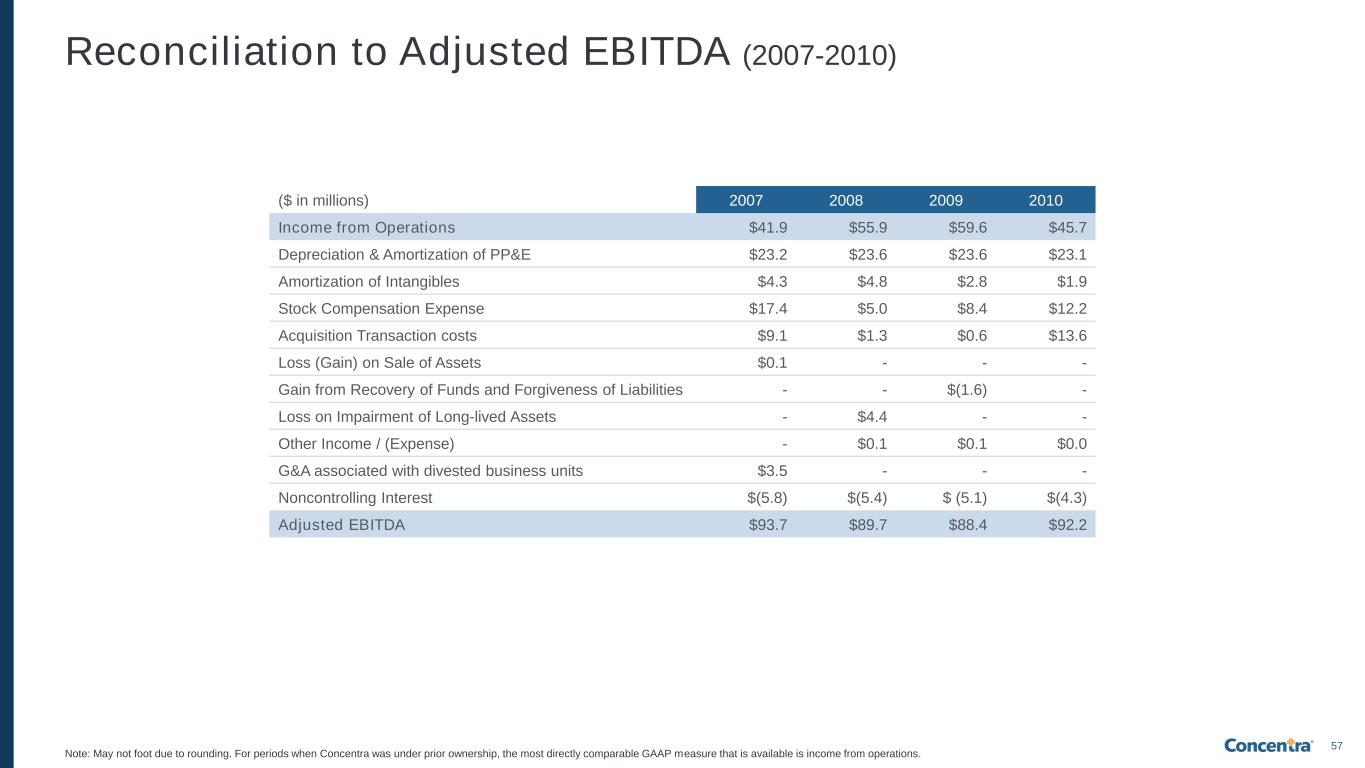
57 Reconciliation to Adjusted EBITDA (2007-2010) Note: May not foot due to rounding. For periods when Concentra was under prior ownership, the most directly comparable GAAP measure that is available is income from operations. ($ in millions) 2007 2008 2009 2010 Income from Operations $41.9 $55.9 $59.6 $45.7 Depreciation & Amortization of PP&E $23.2 $23.6 $23.6 $23.1 Amortization of Intangibles $4.3 $4.8 $2.8 $1.9 Stock Compensation Expense $17.4 $5.0 $8.4 $12.2 Acquisition Transaction costs $9.1 $1.3 $0.6 $13.6 Loss (Gain) on Sale of Assets $0.1 - - - Gain from Recovery of Funds and Forgiveness of Liabilities - - $(1.6) - Loss on Impairment of Long-lived Assets - $4.4 - - Other Income / (Expense) - $0.1 $0.1 $0.0 G&A associated with divested business units $3.5 - - - Noncontrolling Interest $(5.8) $(5.4) $ (5.1) $(4.3) Adjusted EBITDA $93.7 $89.7 $88.4 $92.2
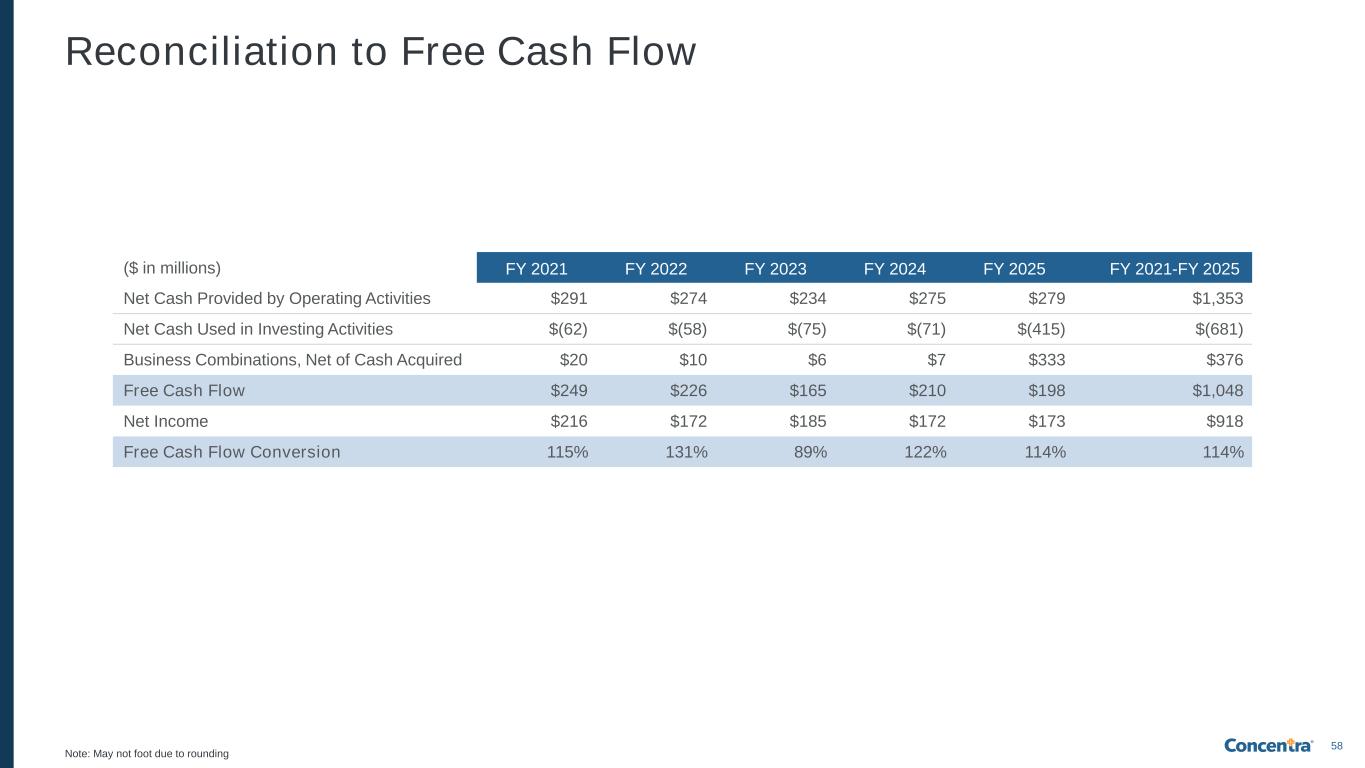
58 Reconciliation to Free Cash Flow Note: May not foot due to rounding ($ in millions) FY 2021 FY 2022 FY 2023 FY 2024 FY 2025 FY 2021-FY 2025 Net Cash Provided by Operating Activities $291 $274 $234 $275 $279 $1,353 Net Cash Used in Investing Activities $(62) $(58) $(75) $(71) $(415) $(681) Business Combinations, Net of Cash Acquired $20 $10 $6 $7 $333 $376 Free Cash Flow $249 $226 $165 $210 $198 $1,048 Net Income $216 $172 $185 $172 $173 $918 Free Cash Flow Conversion 115% 131% 89% 122% 114% 114%
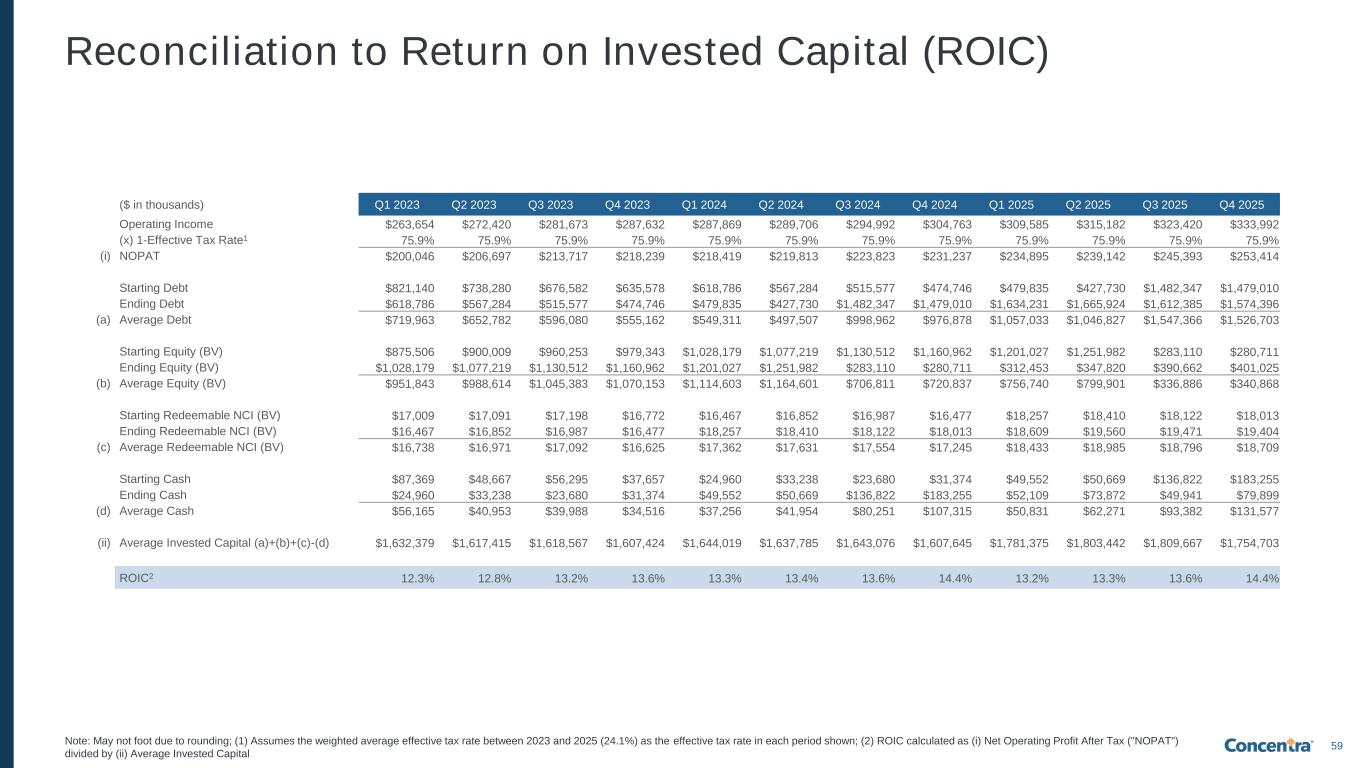
59 Reconciliation to Return on Invested Capital (ROIC) Note: May not foot due to rounding; (1) Assumes the weighted average effective tax rate between 2023 and 2025 (24.1%) as the effective tax rate in each period shown; (2) ROIC calculated as (i) Net Operating Profit After Tax ("NOPAT") divided by (ii) Average Invested Capital ($ in thousands) Q1 2023 Q2 2023 Q3 2023 Q4 2023 Q1 2024 Q2 2024 Q3 2024 Q4 2024 Q1 2025 Q2 2025 Q3 2025 Q4 2025 Operating Income $263,654 $272,420 $281,673 $287,632 $287,869 $289,706 $294,992 $304,763 $309,585 $315,182 $323,420 $333,992 (x) 1-Effective Tax Rate1 75.9% 75.9% 75.9% 75.9% 75.9% 75.9% 75.9% 75.9% 75.9% 75.9% 75.9% 75.9% (i) NOPAT $200,046 $206,697 $213,717 $218,239 $218,419 $219,813 $223,823 $231,237 $234,895 $239,142 $245,393 $253,414 Starting Debt $821,140 $738,280 $676,582 $635,578 $618,786 $567,284 $515,577 $474,746 $479,835 $427,730 $1,482,347 $1,479,010 Ending Debt $618,786 $567,284 $515,577 $474,746 $479,835 $427,730 $1,482,347 $1,479,010 $1,634,231 $1,665,924 $1,612,385 $1,574,396 (a) Average Debt $719,963 $652,782 $596,080 $555,162 $549,311 $497,507 $998,962 $976,878 $1,057,033 $1,046,827 $1,547,366 $1,526,703 Starting Equity (BV) $875,506 $900,009 $960,253 $979,343 $1,028,179 $1,077,219 $1,130,512 $1,160,962 $1,201,027 $1,251,982 $283,110 $280,711 Ending Equity (BV) $1,028,179 $1,077,219 $1,130,512 $1,160,962 $1,201,027 $1,251,982 $283,110 $280,711 $312,453 $347,820 $390,662 $401,025 (b) Average Equity (BV) $951,843 $988,614 $1,045,383 $1,070,153 $1,114,603 $1,164,601 $706,811 $720,837 $756,740 $799,901 $336,886 $340,868 Starting Redeemable NCI (BV) $17,009 $17,091 $17,198 $16,772 $16,467 $16,852 $16,987 $16,477 $18,257 $18,410 $18,122 $18,013 Ending Redeemable NCI (BV) $16,467 $16,852 $16,987 $16,477 $18,257 $18,410 $18,122 $18,013 $18,609 $19,560 $19,471 $19,404 (c) Average Redeemable NCI (BV) $16,738 $16,971 $17,092 $16,625 $17,362 $17,631 $17,554 $17,245 $18,433 $18,985 $18,796 $18,709 Starting Cash $87,369 $48,667 $56,295 $37,657 $24,960 $33,238 $23,680 $31,374 $49,552 $50,669 $136,822 $183,255 Ending Cash $24,960 $33,238 $23,680 $31,374 $49,552 $50,669 $136,822 $183,255 $52,109 $73,872 $49,941 $79,899 (d) Average Cash $56,165 $40,953 $39,988 $34,516 $37,256 $41,954 $80,251 $107,315 $50,831 $62,271 $93,382 $131,577 (ii) Average Invested Capital (a)+(b)+(c)-(d) $1,632,379 $1,617,415 $1,618,567 $1,607,424 $1,644,019 $1,637,785 $1,643,076 $1,607,645 $1,781,375 $1,803,442 $1,809,667 $1,754,703 ROIC2 12.3% 12.8% 13.2% 13.6% 13.3% 13.4% 13.6% 14.4% 13.2% 13.3% 13.6% 14.4%